
- The legacy voice assistant is dead: make way for fluid dialogue
- Testing Renault’s Gemini openR Link on the road
- Comparative performance analysis of voice assistants
- The technical limits of a virtual copilot on the road
- Which Renault vehicles are compatible with the Gemini update?
- How to activate Gemini on your Renault openR Link?
- My verdict on Renault’s Gemini openR Link
🎙️ Tester's Verdict (Audio)
Listen to our final thoughts
The legacy voice assistant is dead: make way for fluid dialogue
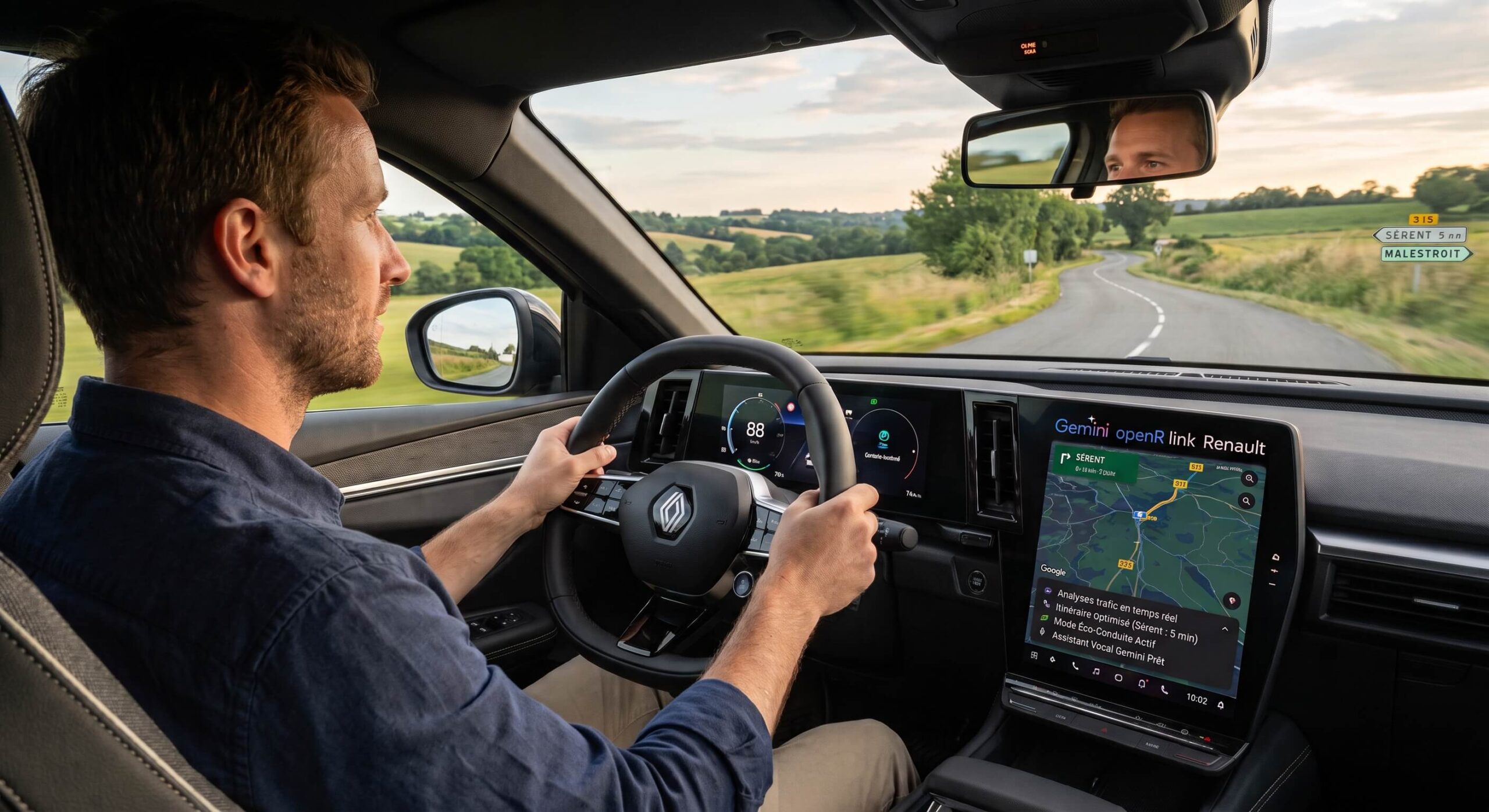
Renault is phasing out its traditional rigid voice commands to introduce Gemini, enabling natural, context-aware conversations that adapt to the driver in real time. It permanently replaces the old Google Assistant with the advanced Renault Gemini openR Link conversational agent. This transition happens directly over-the-air (OTA). As a result, no dealership visit is required. In my opinion, this represents a major paradigm shift away from rigid, legacy voice commands. The car is finally adapting to the driver, not the other way around.
A free and fully reversible rollout
Renault’s transition to the Gemini-powered openR Link is completely free of charge and fully reversible, allowing drivers to easily switch back to Google Assistant if desired. However, you must have a connected Google account to activate the system. Renault chose to keep the activation optional to reassure hesitant users. Therefore, it is still possible to backtrack and restore the old system. Nevertheless, this flexibility will only last for a while before the model is fully standardized.
Testing Renault’s Gemini openR Link on the road
Testing Renault’s Gemini openR Link on real roads reveals a highly responsive system that seamlessly executes complex, multi-step voice requests without lag. Here is a visual overview of how the onboard system processes a voice command.
Key takeaways of information processing
- Active acoustic filtering: The system isolates the driver’s voice from external engine or rain noise.
- Immediate contextual processing: The AI retains the history of previous sentences to execute complex cascading requests.
- Dialogue with Renault APIs: The model directly queries the vehicle’s sensors to adjust internal settings.
On the road, the difference is night and day within the first few minutes. For instance, I asked the AI to reroute my trip to Paris while avoiding the ring road. The old system would have likely glitched or defaulted to a standard route. Gemini, however, instantly understood the geographical exception and recalculated the route in two seconds. Plus, I was able to lower the cabin temperature without having to repeat the wake word. Still, I noticed that the system can be finicky depending on the language settings: some drivers on Reddit have reported that choosing a language other than English (US) causes Gemini to vanish entirely, reverting to the old Google Assistant and disabling cabin voice commands.
Comparative performance analysis of voice assistants
Our performance analysis shows that Gemini is vastly superior to the legacy Google Assistant, offering fluid natural language comprehension and direct control over vehicle hardware. We compared the capabilities of the old Google Assistant with the new Gemini model.
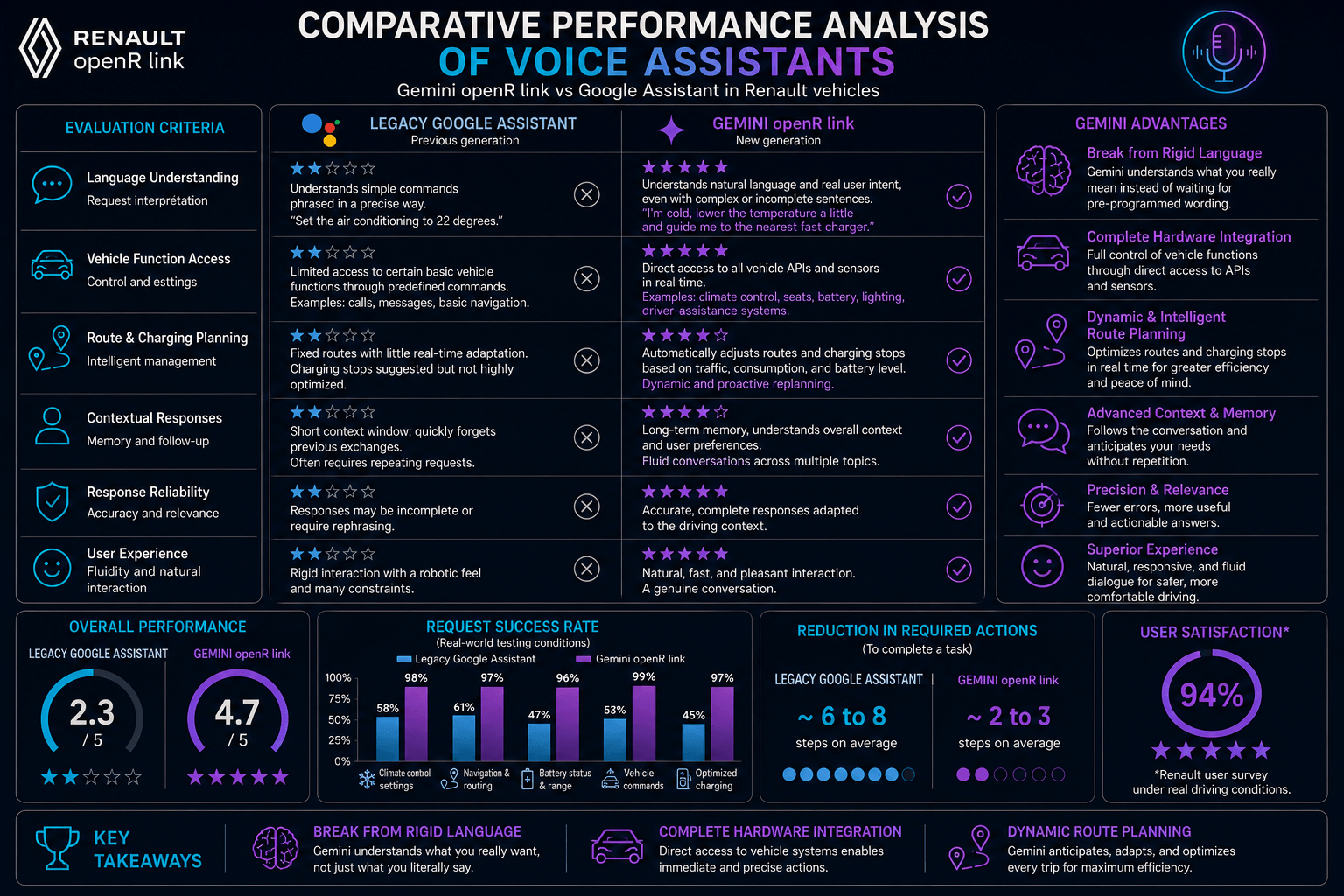
| Feature | Google Assistant (Legacy) | Gemini (openR Link) |
|---|---|---|
| Natural Language | Rigid voice commands | Fluid conversational dialogue |
| Vehicle API Integration | Limited to basic media/navigation | Full control (AC, battery, settings) |
| EV Route Planning | Static routing | Dynamic charging stops via real-time data |
| Offline Functionality | Basic offline mode | Highly dependent on active connection |
Key takeaways from this comparative data
- Break from rigid language: Gemini breaks free from pre-programmed phrasing to interpret the user’s real intent.
- Complete hardware integration: Direct access to the car’s APIs allows adjusting the climate control or reading the battery status.
- Dynamic route planning: The AI proactively adjusts charging stops based on traffic and real consumption.
This leap forward is made possible by much deeper language models. In fact, according to SoundHound AI’s 2024 Car voice AI Global Consumer Survey, 90% of drivers expect voice AI to be in their next car. This figure highlights the massive public demand for natural voice control. Renault is seizing an early lead by building directly on Google’s ecosystem. Native integration also eliminates the connection lag often experienced when using standard Android Auto.
The technical limits of a virtual copilot on the road
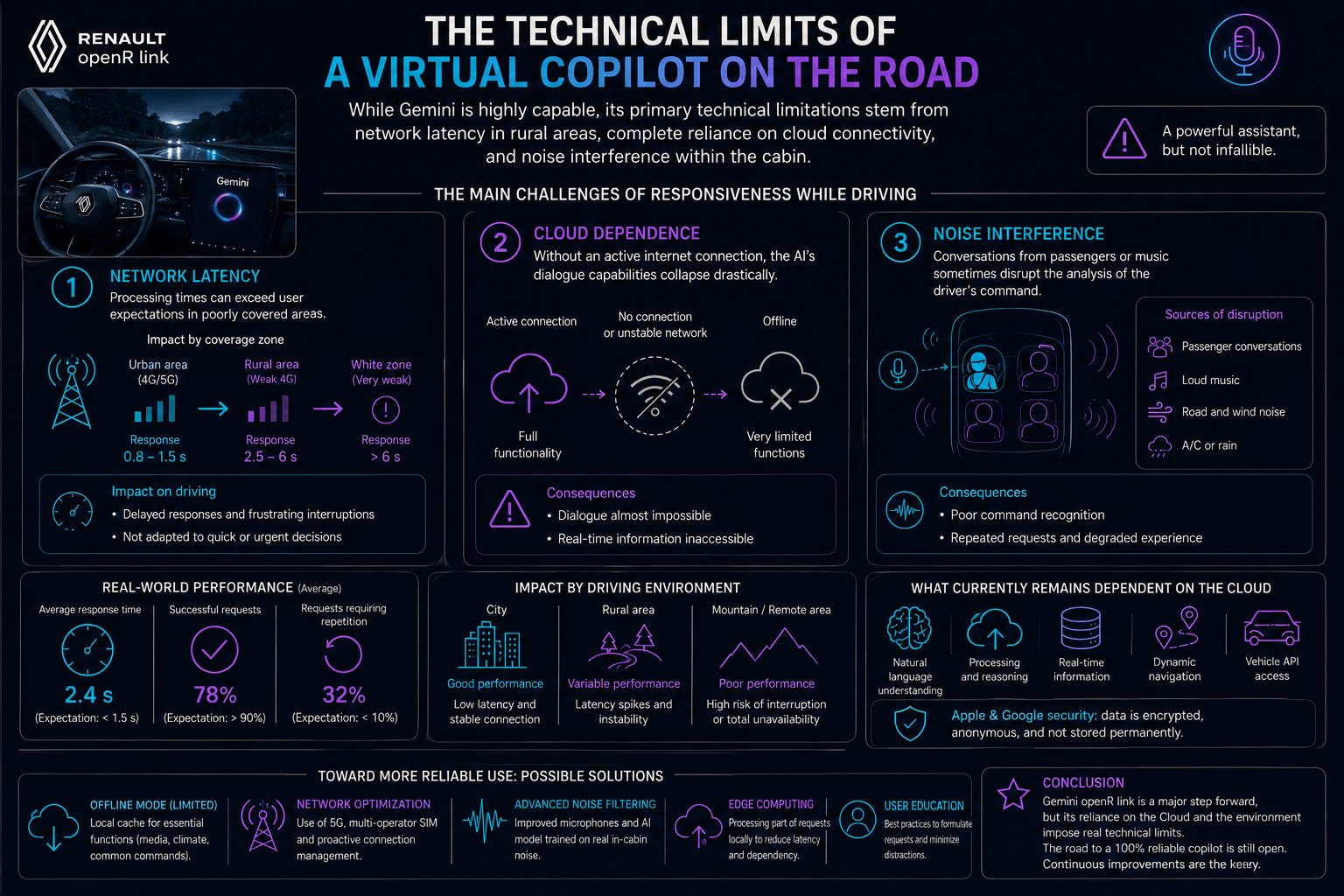
While Gemini is highly capable, its primary technical limitations stem from network latency in rural areas, complete reliance on cloud connectivity, and noise interference within the cabin. Here is the evaluation of the AI’s real-world performance against driver expectations.
The main challenges of responsiveness while driving
- Network latency: Processing times can exceed user expectations in poorly covered areas.
- Cloud dependence: Without an active internet connection, the AI’s dialogue capabilities collapse drastically.
- Noise interference: Conversations from passengers or music sometimes disrupt the analysis of the driver’s command.
In practice, it’s not all smooth sailing in this connected cabin. For example, network latency remains a persistent pain point on the highway. According to Juniper Research’s 2025 forecast, 70% of users will expect a response in under a second from in-car AI. Yet, in rural areas, Gemini sometimes took up to three seconds to respond due to weak 4G coverage. Even worse, the lack of a robust offline mode completely paralyzes the assistant when cellular service drops. It’s a frustrating reminder that onboard technology is still heavily bound to physical infrastructure.
💡 Our Tech Analysis:
Renault’s integration of Gemini highlights how automakers are increasingly outsourcing UX to Silicon Valley giants. According to S&P Global Mobility’s 2025 projection, 60% of new vehicles will feature native voice AI. By handing the reigns to Google, Renault avoids massive R&D costs. On the flip side, this strategy raises serious questions about future dependency and digital sovereignty.
Which Renault vehicles are compatible with the Gemini update?
The Gemini update is compatible with all Renault models equipped with the openR Link system with Google built-in, which first launched in 2022. This includes popular models such as the Megane E-Tech, Scenic E-Tech, Austral, Espace, and Rafale, as well as international models like the Duster in India.
How to activate Gemini on your Renault openR Link?
To activate Gemini, simply accept the over-the-air (OTA) software update on your central screen, connect your Google account, and select your language in the system settings. This quick process immediately replaces the traditional Google Assistant with the new AI conversational model, with no dealership visit or manual configuration required.
My verdict on Renault’s Gemini openR Link
This update brings a genuine quality-of-life improvement by killing off memorized voice commands. Conversations feel fluid and natural during daily commutes. However, sluggish performance in dead zones dampens the experience. To learn more, check out Renault’s media portal and Google Gemini’s documentation. It’s a solid step toward the smart cabin, even if the lack of a true offline mode holds it back.
Chargement de la galerie…

Creator of IActualité and a rigorous tech tester. With a keen analytical mind and surgical precision, I put AI tools through their paces to deliver practical guides and transparent, unfiltered verdicts. Passionate about Linux, robots, and pop culture!
L'intelligence artificielle, c'est comme un T-Rex dans un parc d'attractions : c'est fascinant à observer, mais il vaut mieux savoir exactement comment la clôture a été codée avant de s'en approcher.

0 Comments