
- Why searching for the magic formula of the ideal prompt is a beginner’s mistake
- The eight-block structure to break down your requests
- The efficiency curve of requests according to their length
- Why natural language has definitively buried technical syntax
- The iteration process through visual style transfer
- The distribution of creative forces according to partner models
- Recommended Reading
🎙️ Tester's Verdict (Audio)
Listen to our final thoughts
A blank screen, a blinking cursor, and the naive hope that a sequence of magic words will produce a visual masterpiece on the first try. By working with these tools, I realized that searching for a universal formula is completely futile. Learning to structure an AI image prompt in a rigorous way remains the only reliable method for obtaining precise results.
Why searching for the magic formula of the ideal prompt is a beginner’s mistake
The perfect universal prompt does not exist because each artificial intelligence model interprets instructions according to its own technical strengths. The success of a visual depends on a flexible construction method adapted to the variations of each engine.
The illusion of the magic word persists among many users. They hope that a technical term will unlock professional quality. In reality, current models no longer need syntactic tricks. They require descriptive clarity. Wanting to freeze a single formula is a trap. Neural networks are constantly evolving. A rigorous method always outperforms temporary tricks.
According to Gartner, 2025, 77% of marketing organizations that have adopted generative AI use it for creative development tasks. This rapid adoption highlights a crucial need for methodological guidelines. Users waste precious time testing random combinations. Understanding the internal workings of algorithms helps avoid this exhausting trial and error.
Each generation engine has its own sensitivity. Submitting the same text to two different tools produces radically distinct interpretations. Adjustments must be made on fine details. We must think of our requests like cake batter. The base remains the same, but the baking varies depending on the oven used. It is this flexibility that distinguishes the professional from the amateur.
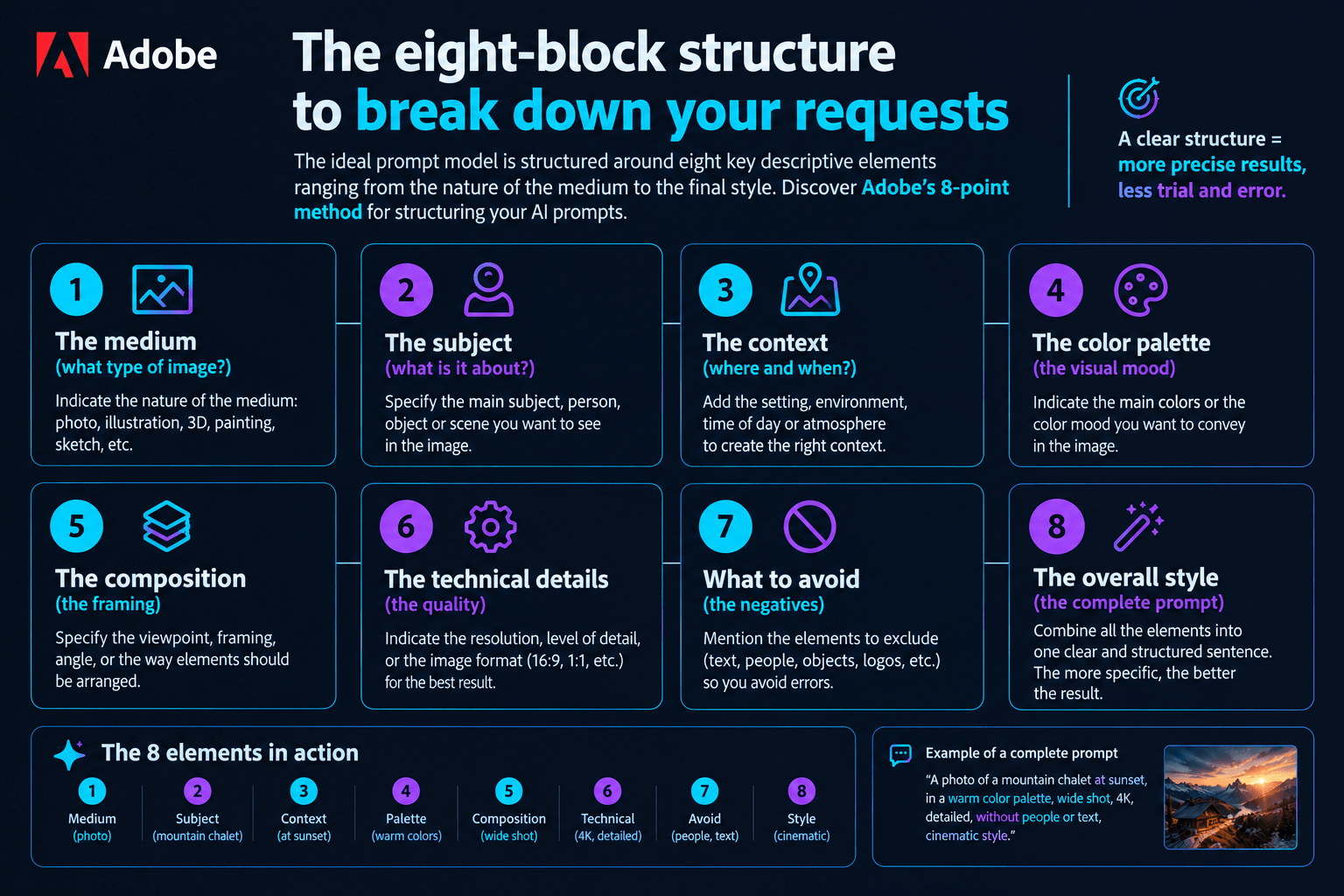
The eight-block structure to break down your requests
The ideal prompt model is structured around eight key descriptive elements ranging from the nature of the medium to the final style. The following diagram illustrates this recommended organization to balance your descriptions.
Key points of the diagram
- Structural balance: Each component provides unique information without encroaching on the others.
- Hierarchy of terms: Placing the most important elements at the beginning of the sentence increases their weight on the final rendering.
Why structuring an AI image prompt changes everything
The absence of structure forces the algorithm to make arbitrary choices. If you forget to specify the lighting, the model will apply a default, often flat light. Methodically structuring your request allows you to maintain creative control over every pixel. This avoids unpleasant surprises during generation.
Here is a concrete example of applying this eight-point method. This text describes a complex scene with surgical precision:
Prompt to copy
Spontaneous, cinematic, and dreamlike photograph of a woman seen from behind, walking in a vast field of tall yellow wildflowers that tower over her, at golden hour. She wears a delicate, translucent dress in natural tones, catching the sunlight. Warm light filters through the flowers and casts delicate shadows on her shoulders and back. Low-angle shot. The mood is ethereal, with slight movement of the flowers, shallow depth of field, and a natural, soft color palette. Vintage grain, golden flares, calm and nostalgic atmosphere. Hyper-realistic.
This level of detail shows how each word plays a precise role. The camera angle, the movement of the elements, and the grain texture combine to create a coherent atmosphere. The artificial intelligence no longer needs to guess your intentions.
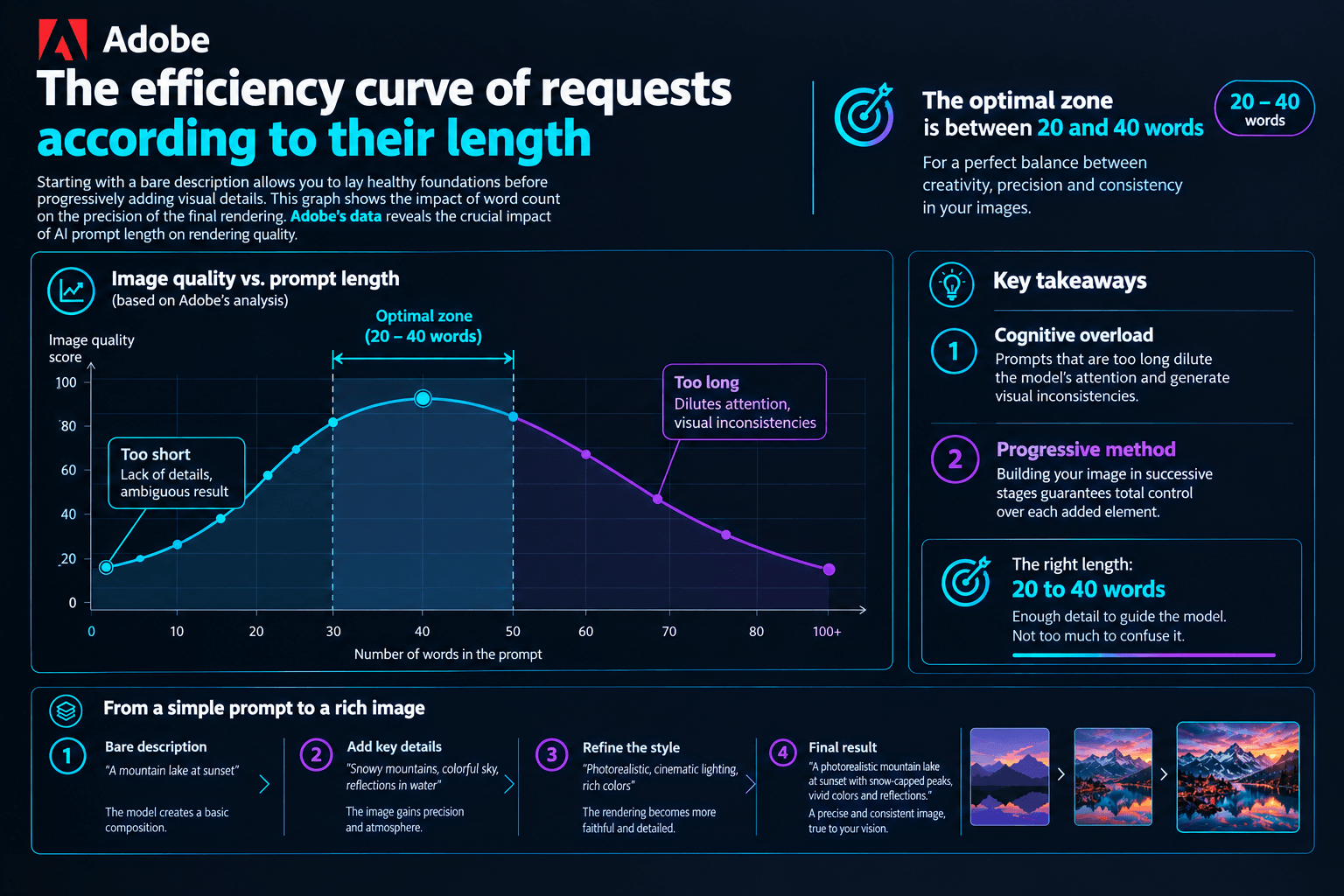
The efficiency curve of requests according to their length
Starting with a bare description allows you to lay healthy foundations before progressively adding visual details. This graph shows the impact of word count on the precision of the final rendering.
Key takeaways from this data
- Cognitive overload: Prompts that are too long dilute the model’s attention and generate visual inconsistencies.
- Progressive method: Building your image in successive stages guarantees total control over each added element.
Experience shows that the extremely long requests found on the web are often useless. By removing half of the superfluous adjectives, you get an identical or even superior result. The model focuses better on the essentials when the text is streamlined.
Semantic overload creates internal conflicts in the algorithm. If you ask for both a dark atmosphere and ultra-bright colors, the system will hesitate and produce a mediocre result. Clarity always takes precedence over text quantity.
Why natural language has definitively buried technical syntax
Modern image generators now decode fluid sentences and the nuances of human language much better than sequences of keywords separated by commas. Writing your requests as you would address a creative colleague yields much more coherent results.
Older versions of models required strange tags to function properly. Users accumulated technical terms to force a clean rendering. That era is over thanks to the integration of advanced language models at the core of visual generators.
The use of precise professional vocabulary remains essential, however. Saying “backlit lighting” is much more effective than writing “a nice light behind the subject.” The algorithm understands the jargon of visual professions.
| Criterion | Keyword generation (old method) | Natural language structure (current method) |
|---|---|---|
| Creative flexibility | Limited, rigid interpretation of isolated terms | High, takes nuances and context into account |
| Prompt portability | Low, strong dependence on a tool’s syntax | Excellent, adaptable structure across multiple models |
| Iteration time | Long, requires numerous syntax adjustments | Short, simple corrections through natural enrichment |
💡 Our Tech Analysis:
Abandoning technical syntax in favor of natural language marks a major turning point. Creatives must no longer behave like coders but like art directors. This freedom demands greater vocabulary precision. Mastering photography and painting terms becomes the true differentiating factor to fully exploit the power of current models.
The iteration process through visual style transfer
Using a reference image allows you to directly indicate the desired aesthetic and composition to the artificial intelligence without getting lost in long text descriptions. This diagram details how the reference image reduces creation steps.
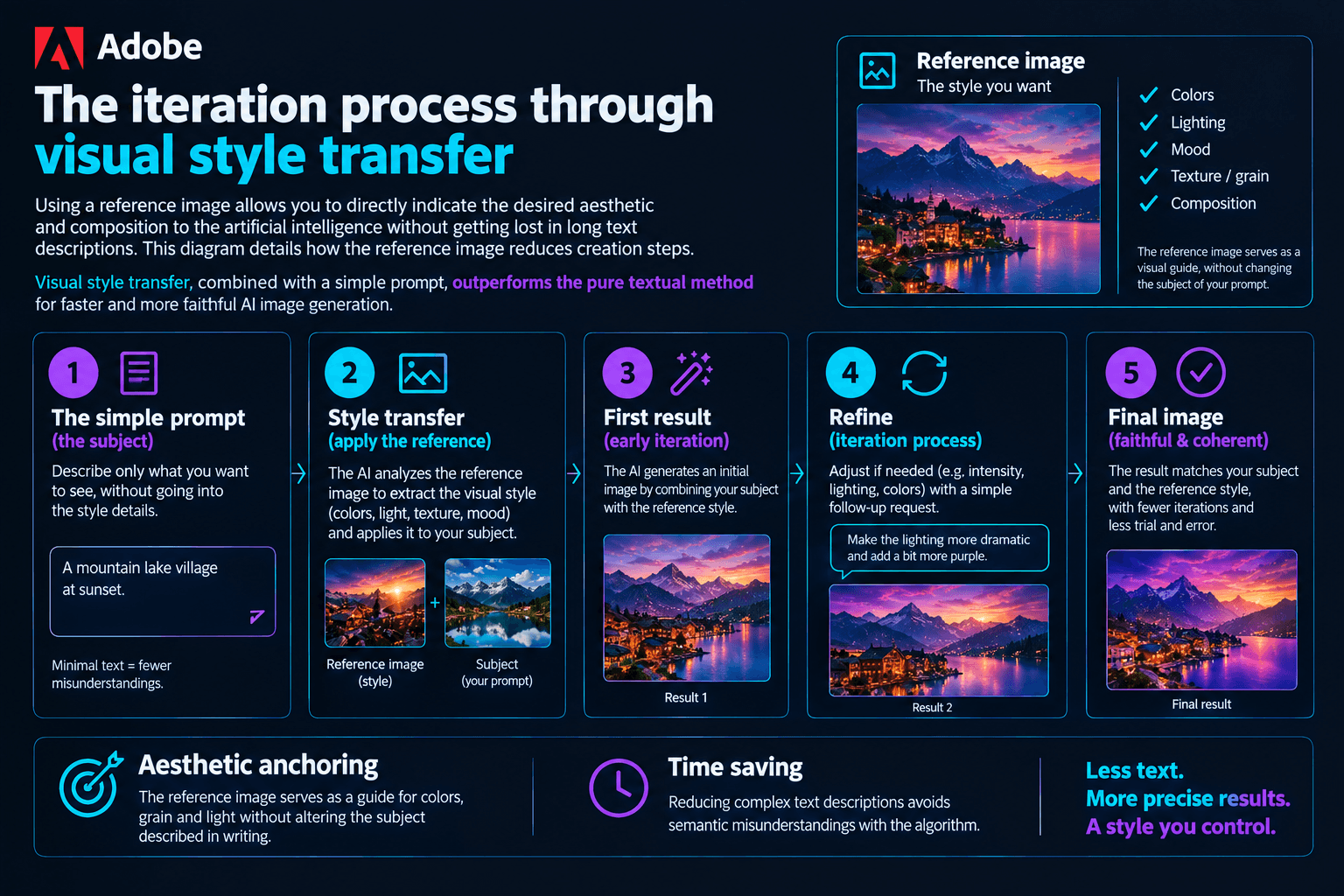
Key points of the diagram
- Aesthetic anchoring: The reference image serves as a guide for colors, grain, and light without altering the subject described in writing.
- Time saving: Reducing complex text descriptions avoids semantic misunderstandings with the algorithm.
Sometimes, words are not enough to express a subtle texture or atmosphere. It is in these moments that the reference image reveals its full utility. It serves as a visual model to guide the algorithm toward the exact aesthetic sought.
This hybrid approach allows for perfect graphic consistency across a series of images. For brands, this ensures compliance with a strict visual identity without having to reinvent the prompt for each creation. In practice, relying on existing visuals often proves more powerful than aligning adjectives to structure an effective AI image prompt.
The distribution of creative forces according to partner models
A prompt built on a healthy structure produces usable results across all major models on the market, even if each engine retains its specificities. This mapping highlights the specialties of the engines integrated into the interface.
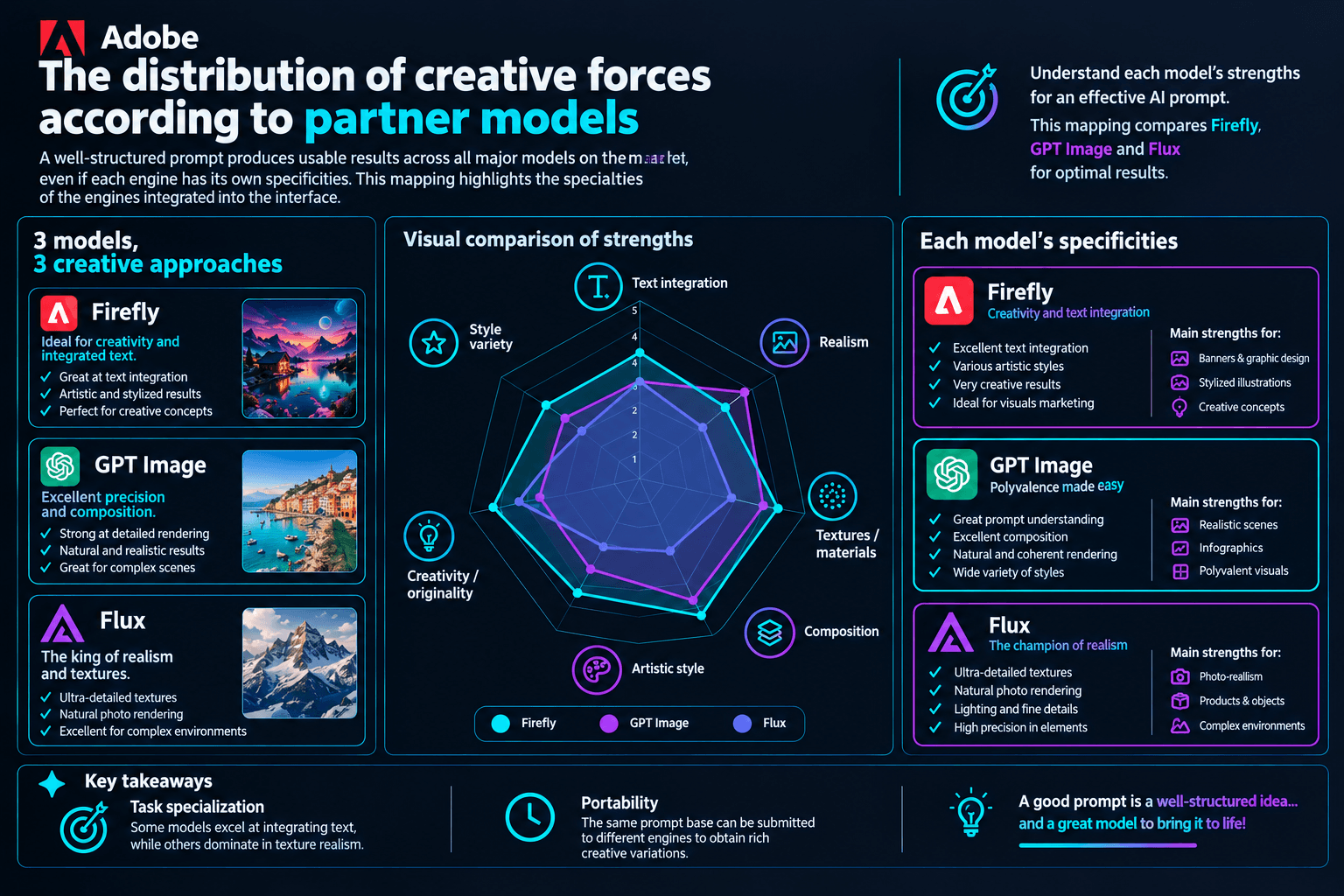
Key takeaways from this data
- Task specialization: Some models excel at integrating written text, while others dominate in texture realism.
- Portability: The same prompt base can be submitted to different engines to obtain rich creative variations.
Modern platforms now integrate several generation engines under a single interface. This diversity allows users to choose the most suitable tool for the task at hand. A model that performs well for drawing letters will be different from one that excels in skin textures.
According to Gartner, 2025, the worldwide generative AI models market grew to $5.7 billion in 2024 from $1.4 billion in 2023. This explosion in volume demonstrates that image generation has become a mass production activity. To remain competitive, mastering the structure of your requests is now indispensable.
Prompting is no longer a matter for shadow engineers, but the new universal language of visual creation.
Chargement de la galerie…


Creator of IActualité and a rigorous tech tester. With a keen analytical mind and surgical precision, I put AI tools through their paces to deliver practical guides and transparent, unfiltered verdicts. Passionate about Linux, robots, and pop culture!
L'intelligence artificielle, c'est comme un T-Rex dans un parc d'attractions : c'est fascinant à observer, mais il vaut mieux savoir exactement comment la clôture a été codée avant de s'en approcher.



0 Comments