

🎙️ Tester's Verdict (Audio)
Listen to our final thoughts
Spotting AI Videos: The Physical Analysis Method
To spot an AI video using physical analysis, you must identify glitches in gravity, unnatural fluid behaviors, and impossible object-to-object interactions that violate real-world physics.
Key Points of Force Interaction
- Contact deformation: Real objects compress and visibly react to physical pressure.
- Conservation of matter: Liquids and solids should never merge or spontaneously evaporate during action.
Video generators do not innately understand the laws of physics. Instead, they simply predict successive pixels based on mathematical probabilities derived from their training. As a result, complex interactions between objects almost always reveal glaring anomalies. For example, watch closely as a hand grabs a coffee cup. In a real scene, the fingers bend and perfectly wrap around the ceramic handle. In contrast, a generative model tends to merge organic matter and the inanimate object. Sometimes, the cup literally passes through the fingers with no visible mechanical resistance.
Furthermore, fluid physics remains a major challenge for these algorithms. Water poured into a glass might pool asymmetrically or mysteriously vanish through the walls. However, these rendering errors tend to fade with recent model releases. That is why our attention must turn to microscopic details. Another common anomaly lies in the weight of moving objects. A ball bouncing on the floor should lose energy with each impact. Yet, AI often generates perfectly linear trajectories or sudden accelerations that defy inertia.
By analyzing these physical details systematically, you can quickly spot the deception. Finally, watch the contact between surfaces. In reality, an object resting on a table creates a very dark contact shadow at its exact base. generative models often omit this micro-shadow, making the object look as if it is floating slightly above the surface.
Facial Decoding: Isolating Anatomical Flaws and Gaze
Facial decoding in AI videos relies on identifying unnatural blinking patterns, mismatched lip movements during speech, and a lack of dynamic muscle tension in the neck or face.
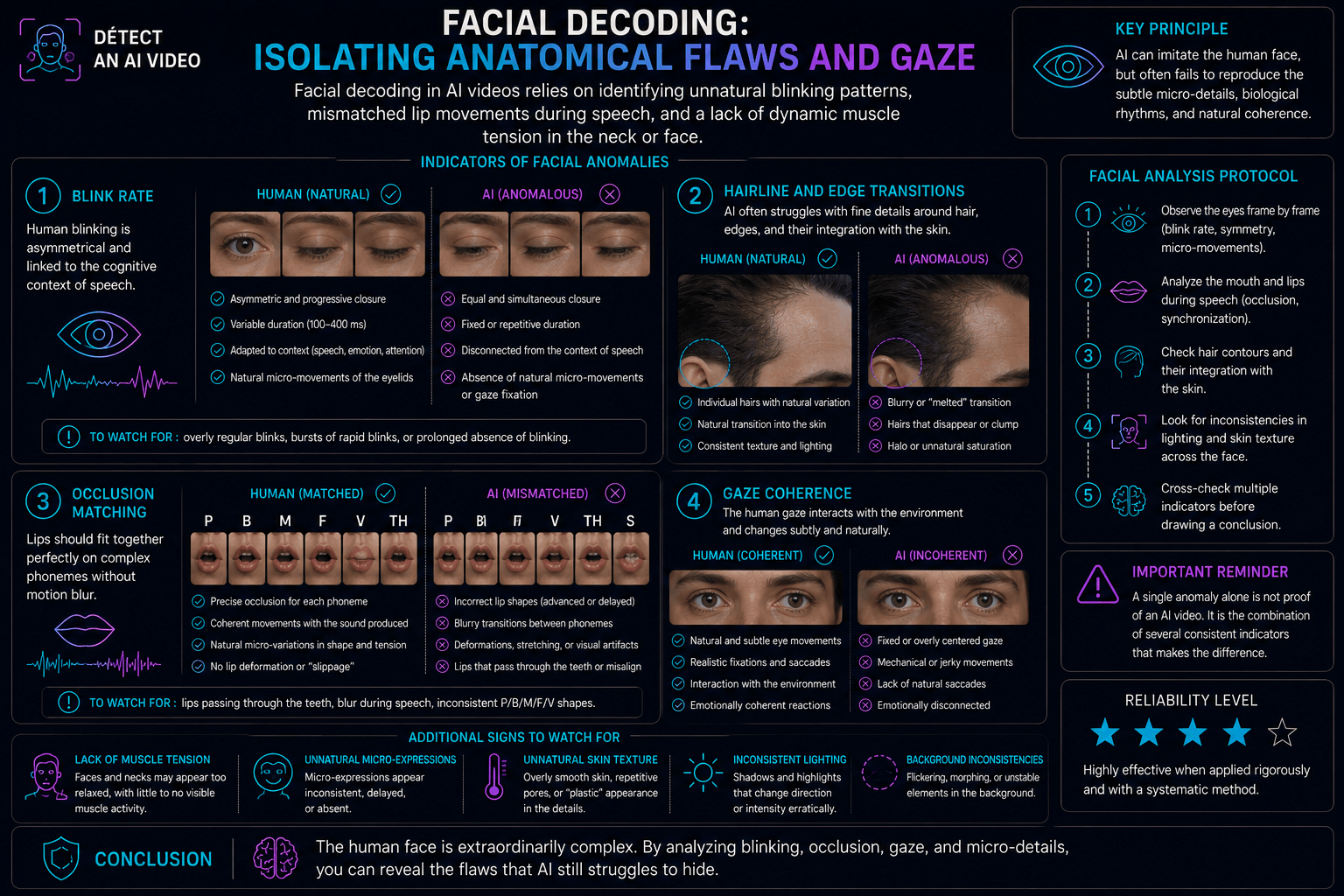
Indicators of Facial Anomalies
- Blink rate: Human blinking is asymmetrical and linked to the cognitive context of speech.
- Occlusion matching: Lips should fit together perfectly on complex phonemes without motion blur.
The human face naturally draws our attention, but it also proves to be the most complex terrain to model for deepfake creators. However, algorithms make subtle mistakes on facial micro-movements. In my opinion, eye blinking is the first point of entry for our analysis. A human blinks irregularly, depending on fatigue or emotion. Synthetic videos, on the other hand, often show blinks that are too periodic or entirely absent for dozens of seconds. In practice, detailed reviews of synthetic footage note that these errors also extend to fluctuating pupil sizes and gaze directions that fail to follow the movement of the camera logically.
Also, look at the transition zone between skin and hair. Fine strands tend to bleed into the forehead in an unrealistic way during head movements. Furthermore, lip-syncing frequently reveals time lags that are imperceptible at first. The sound of a plosive consonant like ‘P’ or ‘B’ must coincide exactly with complete lip closure. If the movement is too fluid or slightly delayed, there is room for doubt. There is also a lack of realistic muscle tension in the neck and jaw. When a character speaks or shouts, vocal cords and neck tendons should tighten in a coordinated way.
AI models frequently forget these secondary anatomical details, creating a floating face effect. Look closely at the skin texture during intense expressions too. Expression lines should appear and disappear dynamically around the eyes and mouth. If the skin remains unnaturally smooth or if wrinkles freeze, you are dealing with generated content.
Background Consistency: Unmasking Temporal Morphing
To unmask temporal morphing in AI videos, closely inspect the background for warping lines, disappearing objects, and shifting shadows that reveal spatial instability.
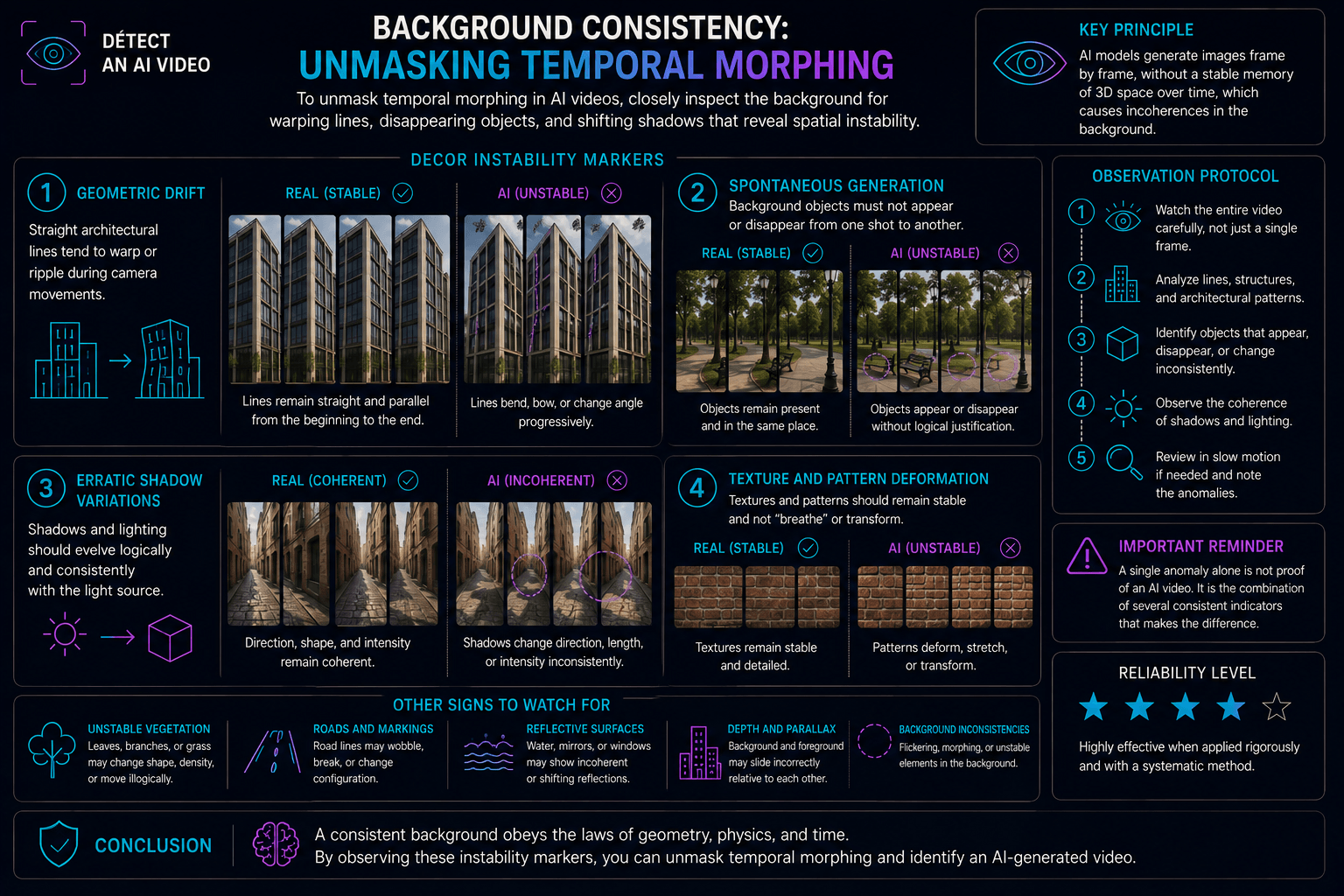
Decor Instability Markers
- Geometric drift: Straight architectural lines tend to warp or ripple during camera movements.
- Spontaneous generation:1 Background objects must not appear or disappear from one shot to another.
Video generators handle object permanence in space very poorly. In practice, the background of a continuous shot undergoes slow, continuous transformations known as temporal morphing. For example, focus on a billboard in the background of a street scene. At the beginning of the clip, the text may seem legible and coherent. However, after three seconds of a tracking shot, the letters warp and turn into abstract symbols. Similarly, windows on a building might multiply or change color with no narrative logic.
This lack of spatial memory is a profound technical limitation of diffusion architecture. Current models generate each frame based on the previous one, but struggle to maintain a stable mental map of the overall environment. Consequently, background textures like cobblestones or brick walls end up sliding or fading away. To catch these errors, I advise breaking down the video frame by frame. By manually scrubbing through the clip, you will often find that cast shadows change angles erratically. A shadow cannot shift ten degrees in a fraction of a second unless the light source moved. This type of lighting inconsistency is irrefutable proof of algorithmic manipulation.
Another key point concerns the background crowd. Secondary characters often have simplified silhouettes that warp grotesquely as soon as they move away from the central camera. Inspecting blurry faces in the background is an excellent shortcut to spot the deception.
| Feature Analyzed | Real Video (Human) | AI-Generated Video |
|---|---|---|
| Physical Interactions | Objects deform realistically; natural contact shadows exist. | Objects merge; fluid physics fail; missing contact shadows. |
| Facial & Eye Details | Irregular, contextual blinking; dynamic muscle and skin tension. | Periodic or absent blinking; static wrinkles; lips-sync lag. |
| Background Stability | Permanent geometry; static background details and lighting. | Temporal morphing; warping lines; mutating details or crowds. |
| Authentication | C2PA compliant; verifiable capture metadata and history. | No verifiable cryptographic signature; metadata is absent or altered. |
The Limits of Automated Detectors and the Power of Metadata
While automated AI detectors frequently fail to keep pace with rapid generative advancements, cryptographic metadata protocols like C2PA offer a reliable, unforgeable method to verify video authenticity. Yet, this blind trust is extremely risky given how fast generative models are evolving. According to a 2024 report by the National Cybersecurity Centre (NCSC) of the UK, automated deepfake detection tools are increasingly struggling to keep pace with the rapid advancements in generative AI, often failing to identify sophisticated synthetic content. If even the creators of these models acknowledge the difficulty in distinguishing their own outputs, how could a third-party tool consistently succeed?
In my opinion, technical salvation lies instead in cryptography and image metadata. The C2PA protocol, backed by the Coalition for Content Provenance and Authenticity, allows an unforgeable digital signature to be injected directly at the source of capture. The C2PA standard’s adoption grew from fewer than 100 member organizations in 2022 to over 1,800 globally by April 2026. By inspecting the metadata of a suspect video file using tools compliant with the C2PA standard, you can trace the file’s modification history. This is currently the only way to get absolute certainty.
Additionally, performing a reverse image search on key screenshots from the video often leads back to the original source of a manipulated clip. By combining this context search with cryptographic signature analysis, you build a solid shield against visual misinformation. Finally, let’s not forget to analyze the soundtrack. Cloned voices often lack natural breathing and tonal variations. A mismatch between ambient noise and the acoustics of the filmed room should immediately alert the analyst.
💡 Our Tech Analysis:
Human visual observation remains our first line of defense, but it shows clear limits as models like Sora 2 scale up. Anatomical clues are slowly fading, replaced by increasingly flawless details. To counter this, imaging professionals must combine step-by-step physical analysis with cryptographic metadata verification. Relying solely on AI detectors is a trap, as these tools are constantly playing catch-up with technological progress.
The Social Media Blindspot: How Compression Strips Provenance
Social media platforms consistently strip cryptographic metadata during video uploads and compression, rendering C2PA content credentials useless for direct online verification. As a result, investigators cannot rely on digital signatures alone and must combine metadata checks with deep visual forensics to spot sophisticated synthetic alterations.
To integrate these habits into your professional daily routine, start by applying the three-second rule. Isolate the first three seconds of any suspicious clip and play them in slow motion at 25% of their original speed. This simple technical trick amplifies physical micro-anomaly and makes morphing flaws impossible for your brain to ignore. When it comes to spotting AI videos, this three-second rule method is incredibly effective.
Chargement de la galerie…

Creator of IActualité and a rigorous tech tester. With a keen analytical mind and surgical precision, I put AI tools through their paces to deliver practical guides and transparent, unfiltered verdicts. Passionate about Linux, robots, and pop culture!
L'intelligence artificielle, c'est comme un T-Rex dans un parc d'attractions : c'est fascinant à observer, mais il vaut mieux savoir exactement comment la clôture a été codée avant de s'en approcher.



0 Comments