


- Beyond Words: When the "Prompt" Becomes a Subtle Art
- Deconstructing the "Perfect Prompt": An Anatomy for Action
- The Essential Components of an Effective Prompt
- Common Pitfalls and How to Avoid Them Daily
- Prompt Engineering: A Key Skill for Productivity and Employment
- The Future of Human-AI Dialogue: Towards a More Intuitive Interface?
I still remember those sleepless nights a few years ago, trying to debug a 2000-line Excel spreadsheet. A stubborn VLOOKUP formula, invisible circular references… It was a losing battle, a sinkhole of time and frustration. Then, AI burst into our daily lives. Initially, I was skeptical, seeing it as just another gadget. I tried asking it things, much like talking to a capricious remote control: keywords, imprecise phrases, and most often, disappointment. My workflow was chaotic, my results random. Until the day I understood that the real leverage wasn’t the tool itself, but how I asked the questions. The famous ‘prompt’.
This small, often underestimated piece of text is, in reality, the thread that connects our intention to the raw power of artificial intelligence. It’s not just a simple instruction; it’s an art, a science, and above all, a skill that is redefining productivity in the digital age. The quality of this initial dialogue determines everything: the relevance, precision, and even the creativity of the responses we receive. In 2025, only 10% of the workforce is expected to be ‘AI competent,’ struggling to formulate effective queries. This highlights the extensive journey ahead to truly democratize the impactful use of these tools.
Beyond Words: When the "Prompt" Becomes a Subtle Art
What many perceive as simple text input is, in reality, a complex interaction. Think of it like a conductor facing a symphony orchestra. A poorly held baton, a vague indication, and it’s cacophony. Precise gestures, well-defined nuances, and it’s harmony. The prompt functions similarly with AI. It’s not about bombarding the model with keywords, but about structuring a thought, embodying a role, providing context, and setting clear constraints. The field of Prompt Engineering, once a niche, has become a discipline in its own right, with growing demand. Roles requiring prompt engineering skills tripled between 2024 and 2026, according to PE Collective data.
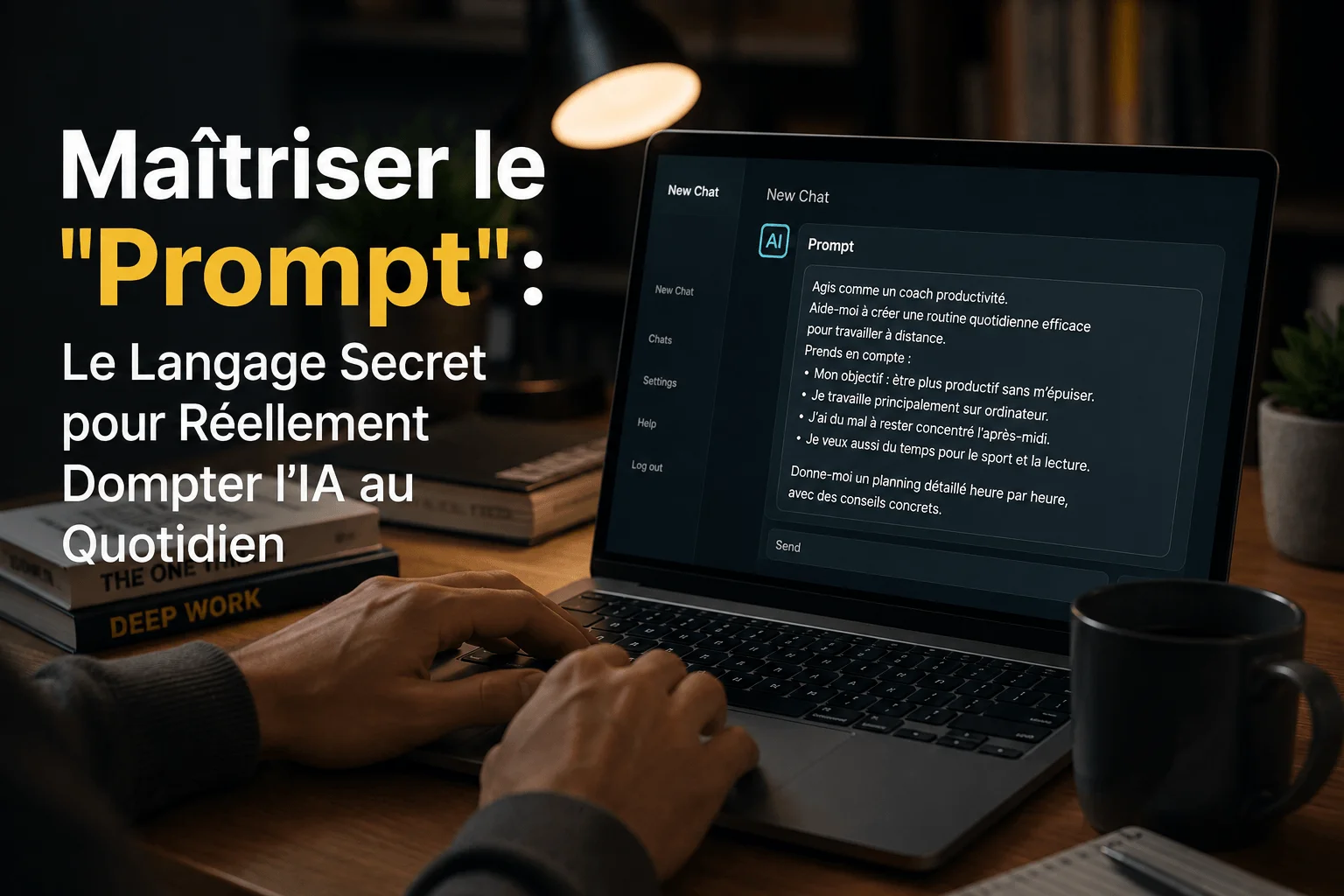
In my opinion, the problem isn’t AI’s ability to understand, but our ability to make ourselves understood. We’ve been conditioned by decades of search engines where conciseness reigned supreme. With generative AI, it’s the opposite: rich context and granular detail are your best allies. A vague prompt like « Write me an email » will only result in a generic response. But by giving it a precise role (a SaaS marketing manager), an objective (introduce invoicing software), an audience (small businesses), a length (150 words), and a call to action (free trial), AI can produce ready-to-use content.
💡 Our Tech Analysis:
The illusion of prompt simplicity is the biggest barrier to effective AI adoption. Models are increasingly powerful, but their performance is hampered by often poorly formulated human queries. This is a technical limitation not inherent to AI, but to the cognitive interface between humans and machines. The real challenge isn’t to make AI smarter, but to make us better at the art of questioning. This asymmetry between the tool’s capability and the user’s skill is a major bottleneck for the everyday democratization of AI.
Deconstructing the "Perfect Prompt": An Anatomy for Action
There’s no universal magic formula, but a set of principles that, once mastered, radically transform results. Prompt engineering is the practice of designing and refining these instructions to guide AI responses. It’s an iterative process, a constant dialogue where each attempt refines mutual understanding. Best practices include specificity, step-by-step instructions, assigning a role to the AI, and using examples. In practice, this means creating a mini-specification for each interaction.
The Essential Components of an Effective Prompt
A well-constructed prompt is like a detailed cooking recipe: every ingredient and every step matters.
Show: (A diagram illustrating the 5 to 7 key components of an effective prompt: AI Role, Context, Task, Constraints (format, length, style), Examples, Success Criteria, Clarification Questions.)
Key Elements of a Successful Prompt Framework
- The Role (Persona): Ask the AI to embody an expert (e.g., “You are a senior Python developer”). This refines its tone and approach.
- The Context: Provide all necessary background information for the AI to understand the situation.
- The Task (Objective): Describe precisely what you expect from it (e.g., “Write an article on the benefits of meditation”).
- Constraints: Specify the format, style, length, tone, or information to include/exclude. Structured prompts increase accuracy by 35%.
- Examples (Few-Shot): If possible, show the AI what you expect with one or more examples. This can triple the quality of results for certain tasks.
- Success Criteria: How will you evaluate the response? What are the indispensable elements?
Common Pitfalls and How to Avoid Them Daily
Despite the enthusiasm, the path is fraught with pitfalls. One of the major frustrations for 28% of users is having to “rewrite the same prompt multiple times.” This is often linked to fundamental errors: ambiguity, lack of detail, or attempting to do too many things at once. This is called “rage prompting” when the user repeatedly asks the same question out of frustration. “Hallucinations” (information invented by the AI) are also more frequent with poorly designed prompts. By 2025, users who feel more comfortable writing prompts are 64% less likely to experience hallucinations.
My experience has taught me that patience and method are paramount. Rather than throwing a gigantic prompt, it’s better to break down the task into smaller steps. This is the principle of “chain-of-thought prompting” or step-by-step instructions. For example, for an article, first ask for an outline, then an introduction, then each section, and finally a conclusion. This allows the AI to focus on one task at a time, significantly reducing errors and increasing relevance. A 2025 Harvard Business Review study also showed that collaboration with AI leads to higher quality work, even if it can sometimes result in a decrease in intrinsic motivation for unassisted tasks.
Show: (A prompt iteration workflow: 1. Vague initial prompt → 2. Unsatisfactory response → 3. Gap analysis → 4. Prompt improvement (adding role, context, constraints) → 5. New improved response → 6. Continuous feedback and adjustment.)
Key Takeaways from This Iterative Process
- Test and Refine: The first draft is rarely the right one. Consider each response as a starting point to improve your query.
- Add Context: Each iteration is an opportunity to inject more details about the subject, audience, or expected format.
- Specify Expectations: If a part of the response is not good, indicate precisely what is missing or what needs to be corrected, rather than starting over.
Prompt Engineering: A Key Skill for Productivity and Employment
The productivity gains brought by a good mastery of prompting are far from anecdotal. Recent studies show that employees with access to enterprise AI tools can save between 40 and 60 minutes per day. Personally, I observe considerable time savings on repetitive tasks or information retrieval, allowing me to focus on analysis and strategy. The quality of AI results is directly proportional to the ingenuity of the prompt: well-designed queries can improve relevance by 42% and reduce errors by 28%.
This has a direct impact on the job market. The title “Prompt Engineer” emerged a few years ago and is positioned as one of the most lucrative AI professions, with annual salaries potentially reaching $350,000 for experts. While the specific title may evolve, the underlying prompt engineering skills are increasingly being integrated into broader roles like AI Engineer or AI Solutions Architect. It is therefore an indispensable transversal skill for anyone wishing to leverage AI, regardless of their field. It’s crucial not just to understand AI, but to know how to speak to it effectively. The global prompt engineering market is expected to experience a compound annual growth rate of 32.8% between 2024 and 2030.
Why Invest in Prompt Mastery?
- Resource Optimization: A good prompt reduces the time spent correcting or re-engaging the AI, transforming a powerful tool into a true assistant.
- Value Creation: By obtaining more precise and relevant results, you create higher quality content, analyses, or solutions.
- Professional Differentiation: In a job market where AI is ubiquitous, mastering dialogue with it is a major competitive advantage.
The Future of Human-AI Dialogue: Towards a More Intuitive Interface?
While the reliance on prompt quality is crucial today, we can ponder its future evolution. Will AIs become so intuitive that they no longer require our detailed instructions? Or will this communication skill become the very foundation of any complex interaction with artificial intelligence? In my view, even with more sophisticated models, the need to guide AI, to give it direction and intent, will never disappear. ‘Prompt engineering’ might evolve towards more visual, more conversational interfaces, but the essence of clear, structured communication will remain. A 2026 University of Pennsylvania study showed that MBA students, without coding expertise, were able to create startup prototypes in four days—an order of magnitude improvement over traditional methods—thanks to the effective use of prompts with tools like Claude Code and Gemini. This demonstrates the transformative potential when human-AI communication is optimized.
Show: (A simplified timeline of prompt evolution: from simple keywords (2020-2022) → to structured instructions (2023-2024) → to conversational/iterative prompting (2025) → towards multimodal and contextual interfaces (2026+).)
Key Trends in the Evolution of AI Conversation
- Interface Simplification: Tools aim to make the prompting process more accessible, even to non-experts.
- Intelligent Contextualization: AI is increasingly better at retaining conversation threads, reducing the need to repeat context.
- Multimodal Prompts: Beyond text, we will increasingly interact with AI via voice, image, or video for ever-richer prompts.
We are on the cusp of an era where our ability to dialogue with machines will be as fundamental as reading and writing. The “prompt” is the language of this new era, and mastering it means securing a prime position in the future of work. Faced with this rapid evolution, the question remains: are we ready to transform our communication methods to truly harness the infinite potential of artificial intelligence?
Chargement de la galerie…

About Rigaud Mickaël
"Creator of IActualité and uncompromising tech tester. Driven by intense analytical focus and surgical precision, I crash-test AI tools to bring you transparent, unfiltered verdicts. Passionate about Linux, robots, and pop culture!"



0 Comments