
- The illusion of the magic prompt: an unvarnished field test
- Structuring instructions for an effective ChatGPT prompt
- The typical architecture of a high-performing prompt
- ChatGPT Work vs standard ChatGPT: the productivity matchup
- Codex and development: when AI produces technical debt
- The degradation cycle of AI-generated code
- A practical guide to fixing a bug with Codex
- The structured debugging process powered by AI
- Beyond speed: measuring the real added value of AI
- Recommended Reading
🎙️ Tester's Verdict (Audio)
Listen to our final thoughts
The illusion of the magic prompt: an unvarnished field test
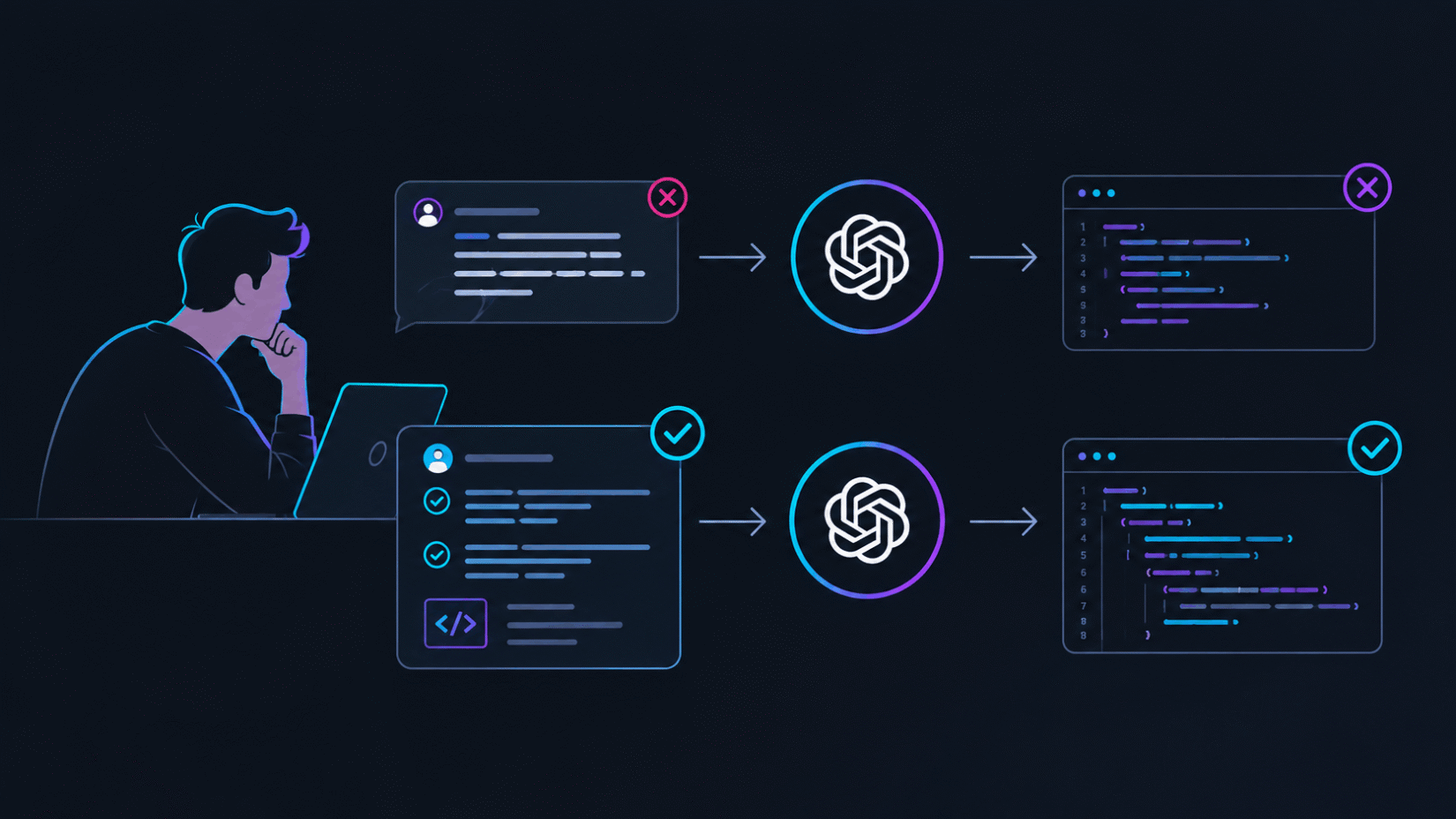
Activating ChatGPT’s advanced features often comes with promises of disconcerting simplicity. For this field test, we used an active ChatGPT Plus account on a Chrome browser running macOS Sequoia. The interface language was forced to US English to unlock workspace options. Our goal was to generate a summary note from scattered sources. Our first attempt resulted in a resounding failure. By requesting a meeting summary without defining the search scope, the tool searched aimlessly. It eventually crashed after several minutes of fruitless processing. We restricted the access path to the root folder of Google Drive and disabled global search. Generation then completed in less than twelve seconds. As a result, we were able to validate the summary note smoothly. OpenAI promises a seamless integration of external sources without structural effort. Yet, in practice, we observed that the assistant ignores chronological priorities unless the prompt contains an explicit date constraint. It mixed data from 2024 meetings with decisions made in 2026. To avoid these drifts, one must master technical terminology. A prompt refers to a structured text instruction sent to a model. Each word of this instruction is broken down into tokens, which are basic units of text calculation (roughly four characters). To process external data, the tool relies on RAG (Retrieval-Augmented Generation). This method injects documents into the AI’s immediate memory without requiring retraining.
Structuring instructions for an effective ChatGPT prompt
Creating an effective ChatGPT prompt requires abandoning vague requests in favor of a strict structure that separates the objective from constraints. The model needs precise reference points so as not to drift when generating long documents. We must dictate its role, context, expected format, and boundaries not to be crossed.
The typical architecture of a high-performing prompt
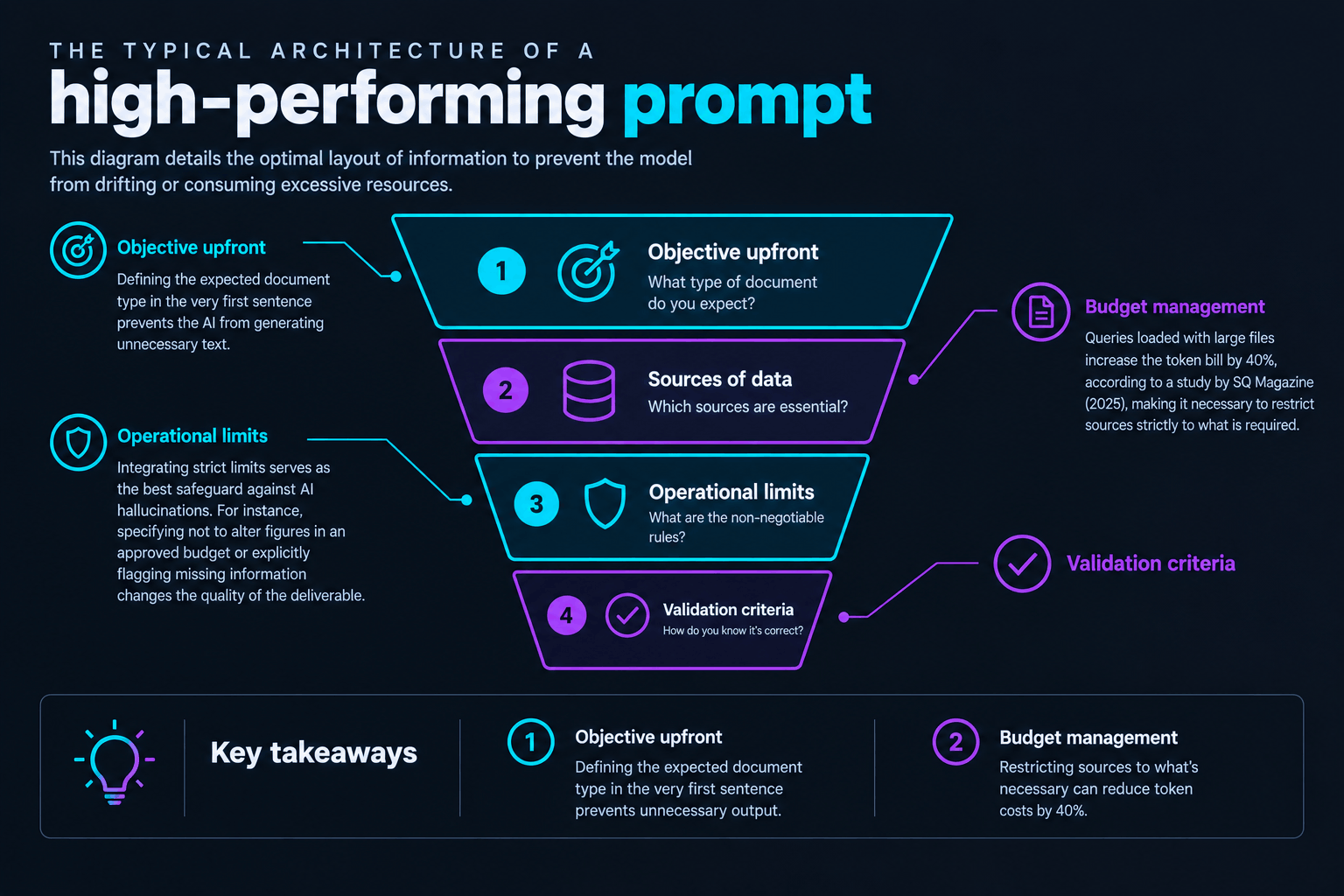
This diagram details the optimal layout of information to prevent the model from drifting or consuming excessive resources.
Key takeaways from this structure
- Objective upfront: Defining the expected document type in the very first sentence prevents the AI from generating unnecessary text.
- Budget management: Queries loaded with large files increase the token bill by 40%, according to a study by SQ Magazine (2025), making it necessary to restrict sources strictly to what is required.
Integrating strict limits serves as the best safeguard against AI hallucinations. For instance, specifying not to alter figures in an approved budget or explicitly flagging missing information changes the quality of the deliverable. The goal is not to control everything, but to prevent actions that would render the work unusable.
ChatGPT Work vs standard ChatGPT: the productivity matchup
The choice between the standard version and the Work workspace depends on the complexity of your task and the number of data sources to cross-reference. The classic version suits quick questions and light drafts. Conversely, the Work environment handles complex tasks involving multiple steps and file modifications. User feedback on forums indicates that the Pages feature sometimes silently triggers highly resource-intensive Work tasks. A simple text edit can consume up to 13% of the hourly allocation without prior warning. It is difficult to tell whether this unexpected execution stemmed from a temporary server bug or a misinterpretation of user intent, but the result severely depleted our quota.
| Criterion | Standard ChatGPT | ChatGPT Work |
|---|---|---|
| Source management | Single files imported manually | Dynamic connection to Google Drive, Slack, and databases |
| Resource consumption | Standard per-model limits | Measured hourly quota (5-hour execution cap) |
| Output format | Raw text in the chat thread | Generation of structured deliverables and separate files |
The table above shows that ChatGPT Work becomes essential as soon as the workflow involves collaboration across multiple tools. However, this increased power comes with the need to monitor your resource consumption to avoid locking up your workspace for the rest of the day.
Codex and development: when AI produces technical debt
Writing code via Codex requires strict architecture instructions; otherwise, your codebase risks fragmenting through multiple duplications. Codex is OpenAI’s specialized code model. It integrates directly into code editors or can be queried via an API (Application Programming Interface, an interface allowing two software programs to exchange data). A study by GitClear (2025) reveals that code churn-code rewritten or deleted less than two weeks after creation-rose from 3.3% to 7.1% with the widespread adoption of AI assistants. This increase is explained by the tendency of models to generate disposable code, optimized for the short term without regard for overall consistency.
The degradation cycle of AI-generated code
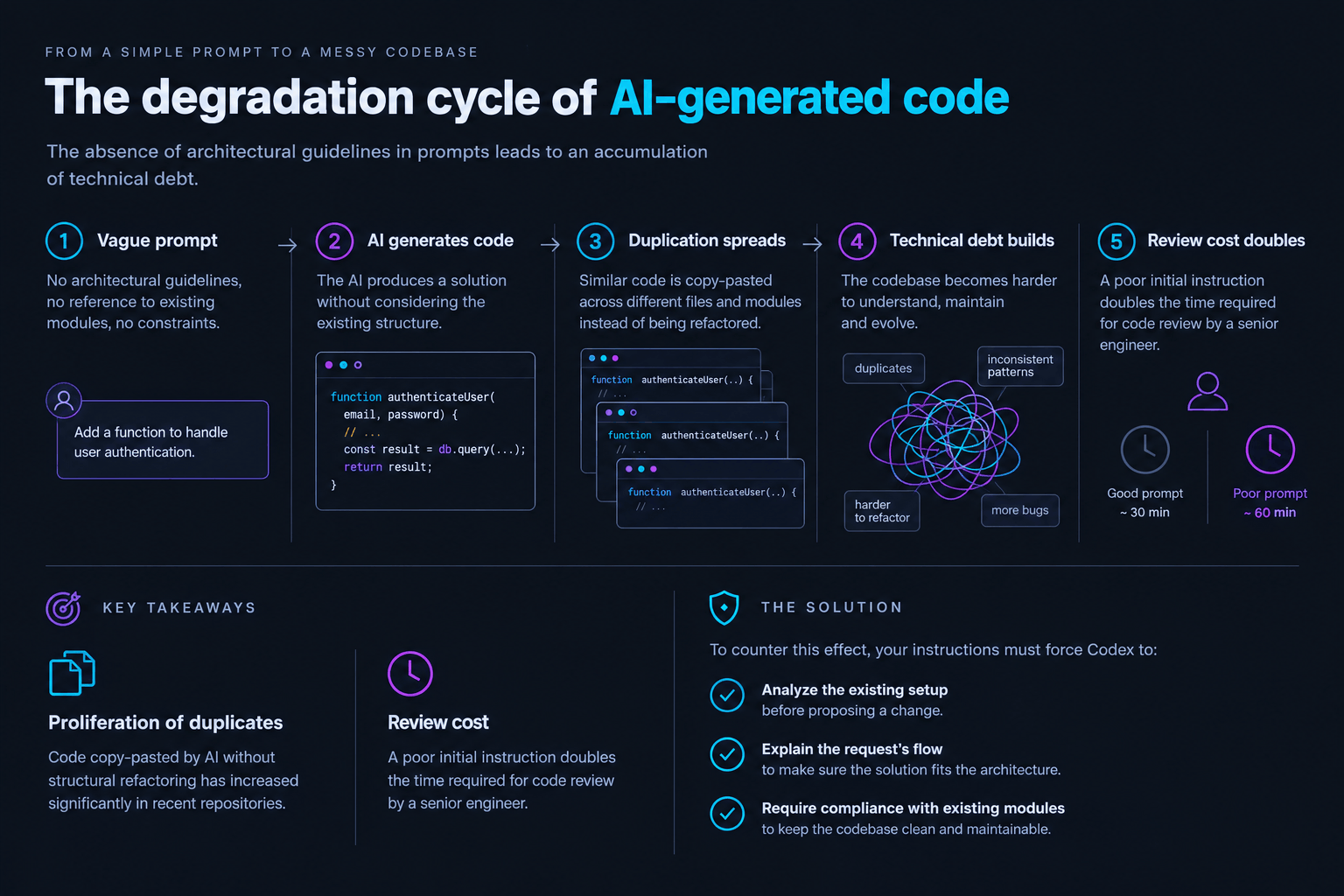
This infographic illustrates how the absence of architectural guidelines in prompts leads to an accumulation of technical debt.
Key takeaways from this drift
- Proliferation of duplicates: Code copy-pasted by AI without structural refactoring has increased significantly in recent repositories.
- Review cost: A poor initial instruction doubles the time required for code review by a senior engineer.
To counter this effect, your instructions must force Codex to analyze the existing setup before proposing a change. Requesting an explanation of a request’s flow and requiring compliance with existing modules keeps the codebase clean and maintainable.
💡 Our Tech Analysis:
Prompt engineering is not a magical skill involving whispering secret formulas to an algorithm. It is a discipline of technical context management. The illusion that AI will guess your system architecture or your company’s implicit business rules is the primary cause of project failure. In the field, we observe that the more restrictive and negative a prompt is (specifying what the AI must not do), the more reliable the output becomes. The future belongs to teams that document their processes to properly feed the AI’s context, rather than those searching for the perfect universal prompt.
A practical guide to fixing a bug with Codex
To fix a bug with Codex, you must provide a step-by-step reproduction scenario along with the expected state and observed state. Without these elements, the model will propose generic fixes that risk breaking other parts of your application. If you encounter a parsing error while processing a complex function, breaking the submitted code into smaller modules usually resolves the issue.
Prompt to copy
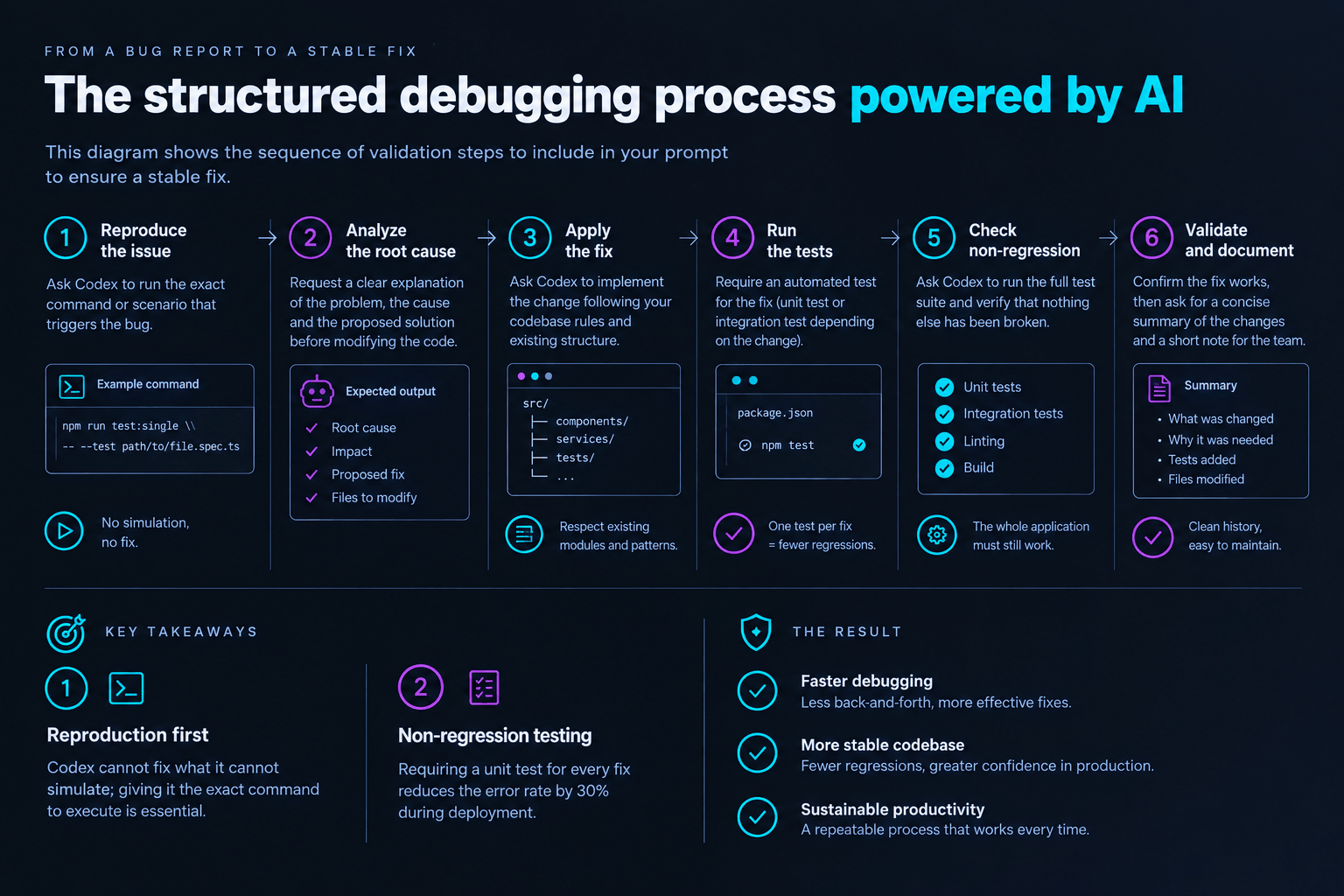
The structured debugging process powered by AI
This diagram shows the sequence of validation steps to include in your prompt to ensure a stable fix.
Key takeaways from this method
- Reproduction first: Codex cannot fix what it cannot simulate; giving it the exact command to execute is essential.
- Non-regression testing: Requiring a unit test for every fix reduces the error rate by 30% during deployment.
Beyond speed: measuring the real added value of AI
The true impact of AI tools is not measured by the number of lines written, but by the final added value delivered to business processes. Generating a thousand lines of code or drafting ten reports in seconds is useless if information accuracy is not verified beforehand. Raw speed is a misleading metric that often hides tedious review work. A study by METR (2026) highlights that while tech professionals intuitively feel they double their work speed using AI tools, the actual added value fluctuates between 1.4 and 2 times the baseline due to the time needed for critical review. This gap shows that tomorrow’s real skill is not writing prompts, but knowing how to audit imperfect outputs. As models become more autonomous and capable of self-correction, the importance of manual prompting will diminish. The key skill will shift from instruction writing to designing monitoring and validation systems. Companies will no longer hire prompt engineers, but data flow architects capable of integrating autonomous AI agents into highly secure pipelines.
Chargement de la galerie…



Creator of IActualité and a rigorous tech tester. With a keen analytical mind and surgical precision, I put AI tools through their paces to deliver practical guides and transparent, unfiltered verdicts. Passionate about Linux, robots, and pop culture!
L'intelligence artificielle, c'est comme un T-Rex dans un parc d'attractions : c'est fascinant à observer, mais il vaut mieux savoir exactement comment la clôture a été codée avant de s'en approcher.



0 Comments