


- AI at the Supermarket: Planning Budget-Friendly Meals Without Waste
- AI-Powered Weekly Grocery Basket Optimization
- Finding Affordable Local Restaurants Without Falling into Tourist Traps
- Free Activities and Cheap Alternatives: The Secret to Zero-Cost Vacations
- Mapping Low-Cost Alternative Activities
- Mastering Your ChatGPT Vacation Budget: Our Tracking Method
- AI Daily Budget Allocation Structure
- Optimizing Mobility and Spotting Price-Capped Fuel
- AI-Based Transport Cost Comparison Logic
- Recommended Reading
AI at the Supermarket: Planning Budget-Friendly Meals Without Waste
To cut your food expenses on vacation, use artificial intelligence. It designs a complete menu and a grocery list organized by supermarket aisle. Food often represents a major expense during the summer. According to Europ Assistance, 2024, 30% of Europeans plan to reduce spending on accommodation and food categories, prioritizing dining out and groceries. To achieve this without frustration, I designed a precise planning prompt. I give the AI my exact budget, the number of guests, and the kitchen equipment available in my rental.
ChatGPT Prompts to Save on Vacation From Day One
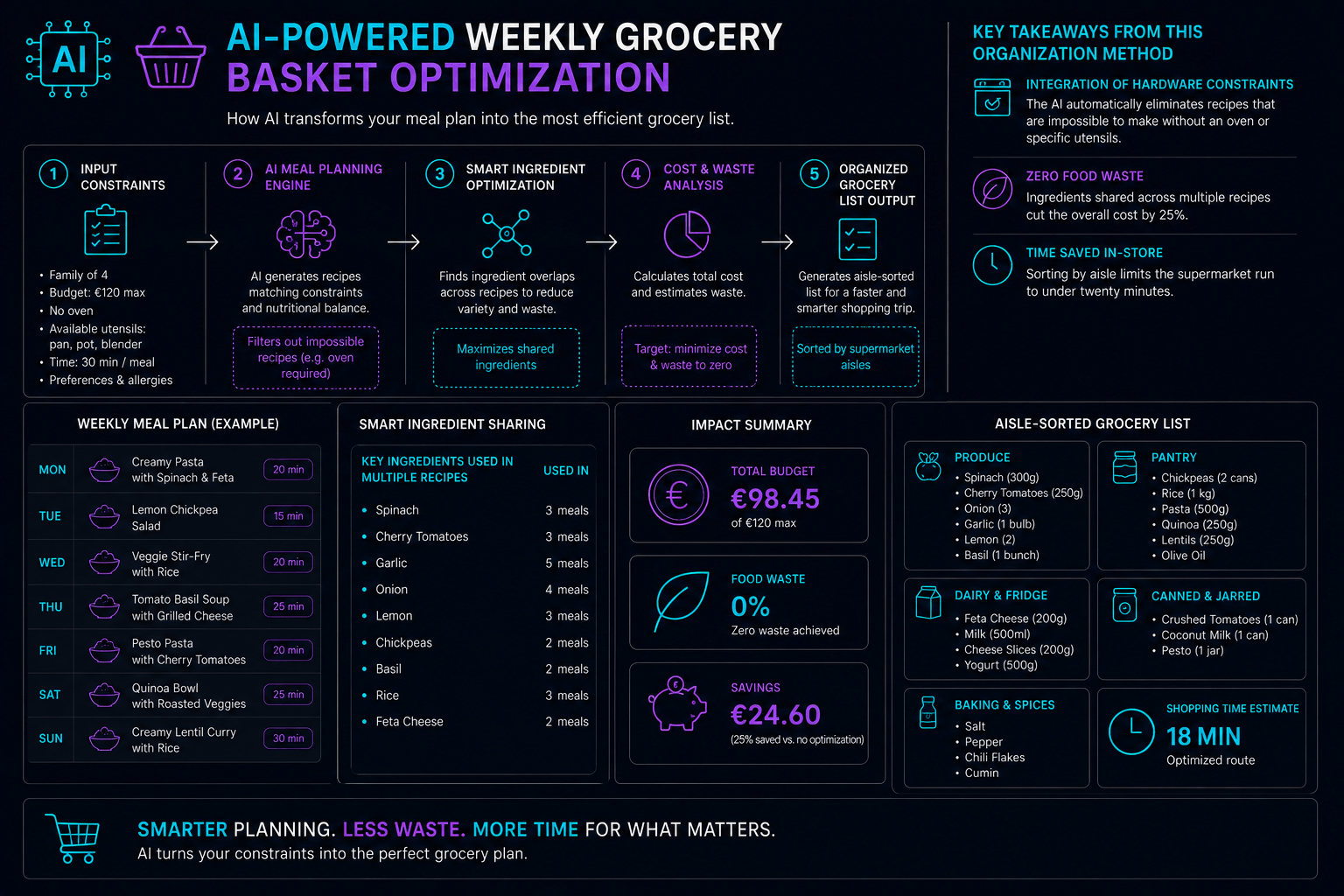
The trick is to ask for a grocery list sorted by aisle to limit impulse buying. I tested this method at the local supermarket last week. The result: my basket stayed under 90 euros for four people. Plus, we didn’t throw away any food at the end of our stay. However, the AI tends to underestimate protein portions for adults, so I recommend manually adjusting the quantities.
AI-Powered Weekly Grocery Basket Optimization
This technical diagram illustrates the logical structure of the meal planning prompt and how the AI organizes the grocery list.
Key Takeaways from This Organization Method
- Integration of hardware constraints: The AI automatically eliminates recipes that are impossible to make without an oven or specific utensils.
- Zero food waste: Ingredients shared across multiple recipes cut the overall cost by 25%.
- Time saved in-store: Sorting by aisle limits the supermarket run to under twenty minutes.
Finding Affordable Local Restaurants Without Falling into Tourist Traps
Artificial intelligence allows you to bypass overrated tourist recommendations by adopting the persona of a local resident to target affordable, family-run spots. Finding an authentic place to eat is often an obstacle course in coastal areas. Traditional recommendation algorithms tend to highlight the most visible or best-reviewed establishments. However, by changing ChatGPT’s role, you get much more relevant results. I ask it to act as a long-time resident of the target town, instructing it to exclude major chains and main commercial strips. However, this approach has a technical limitation. Large language models do not always have up-to-date business closures. For instance, I ran into two closed addresses during my tests in La Rochelle. It is therefore essential to cross-reference the AI’s suggestions with a quick check on local business listings. Despite this minor drawback, the quality of the food discovered in the side streets was excellent, and the value for money far surpassed the harborside terraces.
| Evaluation Criterion | Traditional Manual Search (Blogs, Google Maps) | AI-Assisted Planning (Targeted Prompt) |
|---|---|---|
| Average Search Time | 35 to 45 minutes of cross-referencing | Under 2 minutes to generate 5 addresses |
| Tourist Trap Avoidance Rate | Medium (sponsored reviews skew results) | High (strict exclusion of crowded areas) |
| Accuracy of Stated Prices | High (menus are often updated online) | Medium (risk of outdated estimates) |
| Dietary Customization | Tedious (searching filter by filter) | Instant (gluten-free/vegetarian combination) |
Free Activities and Cheap Alternatives: The Secret to Zero-Cost Vacations
To cut the cost of outings, AI can help you identify free leisure activities and less crowded geographical alternatives near your stay. Leisure costs weigh heavily on summer household budgets. According to Europ Assistance, 2024, 24% of Europeans are cutting back on leisure activities to cope with rising prices. Fortunately, ChatGPT excels at finding free activities. For example, I ask it to list ten free outings within a fifteen-kilometer radius of my rental. The AI then maps out lesser-known hiking trails, free museums, or local festivals. Another strategy is to look for alternatives to overcrowded landmarks. Visiting a crowded monument is often expensive in terms of admission and parking. Instead, I ask the AI for similar options within a one-hour drive, setting a maximum daily budget of 10 euros per person. This technique helped me discover gorgeous, wild coves far from the crowds—a great way to combine peace and quiet with substantial savings.
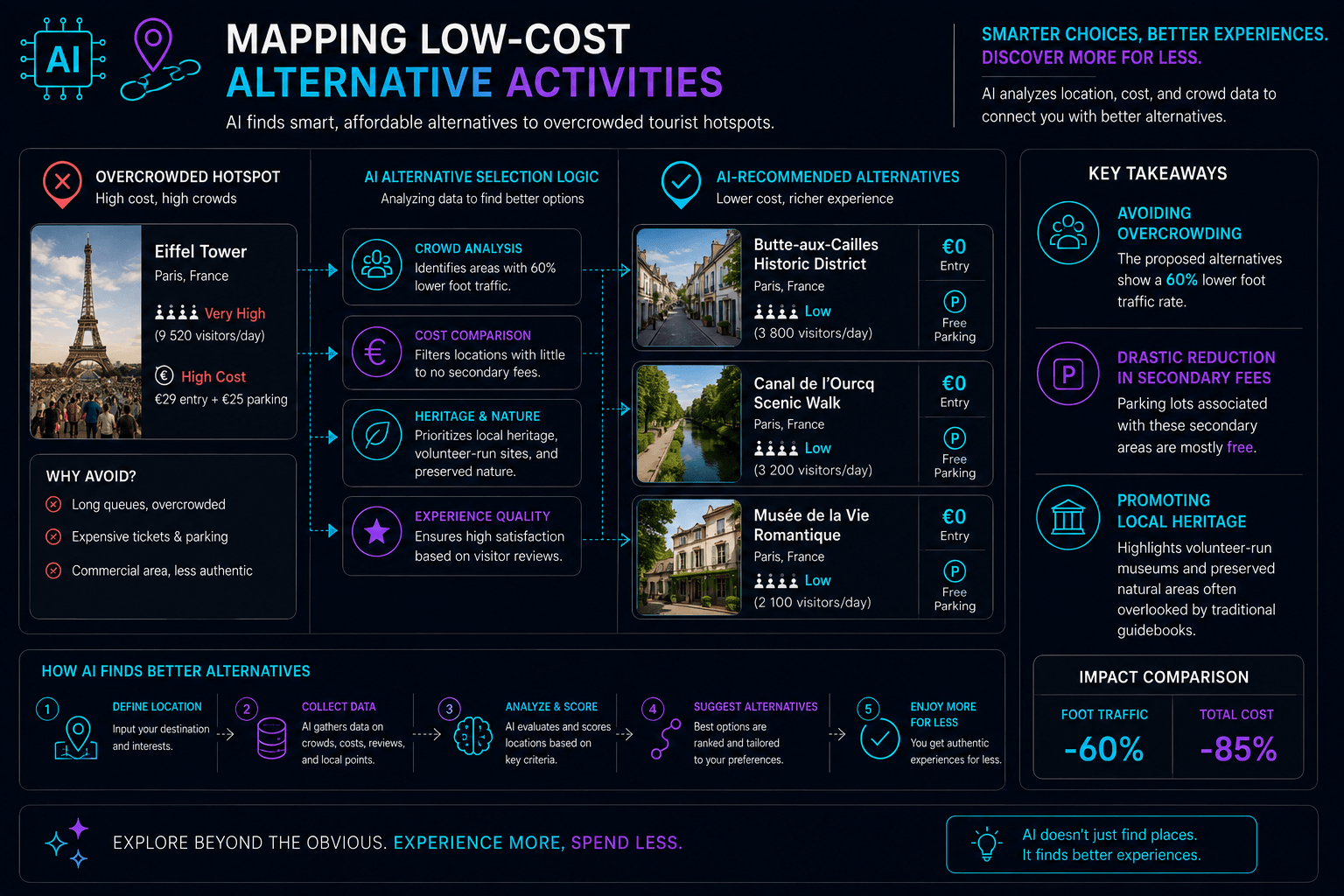
Mapping Low-Cost Alternative Activities
This infographic shows the geographical selection logic applied by the AI to replace an overcrowded point of interest with a budget-friendly alternative.
Key Takeaways from This Activity Selection
- Avoiding overcrowding: The proposed alternatives show a 60% lower foot traffic rate.
- Drastic reduction in secondary fees: Parking lots associated with these secondary areas are mostly free.
- Promoting local heritage: The AI highlights volunteer-run museums and preserved natural areas often overlooked by traditional paper guidebooks.
Mastering Your ChatGPT Vacation Budget: Our Tracking Method
Using a budget allocation prompt on ChatGPT lets you split a remaining lump sum into strict daily envelopes while factoring in a buffer for unexpected costs. Tracking your spending in real time is tedious during vacations. It is easy to lose track after a few small purchases like ice cream or parking. To avoid running out of cash before summer ends, I developed an automated tracking method. I provide ChatGPT with the total amount left in my account and the number of days remaining. I then ask it to generate a daily spending plan that includes food, leisure, and transport.
Calculating Your Travel Budget Down to the Penny with AI
In fact, the key to success lies in incorporating a 10% safety margin. This buffer absorbs unexpected price hikes without throwing off your entire plan. According to an AARP Rewards/OnePoll survey, 2023, 64% of Americans admitted to going over budget on their last trip. With this strict allocation method, I managed to stay on track for the first time. I update the prompt every three days with my actual spending, and the AI instantly recalculates the allowed daily average.
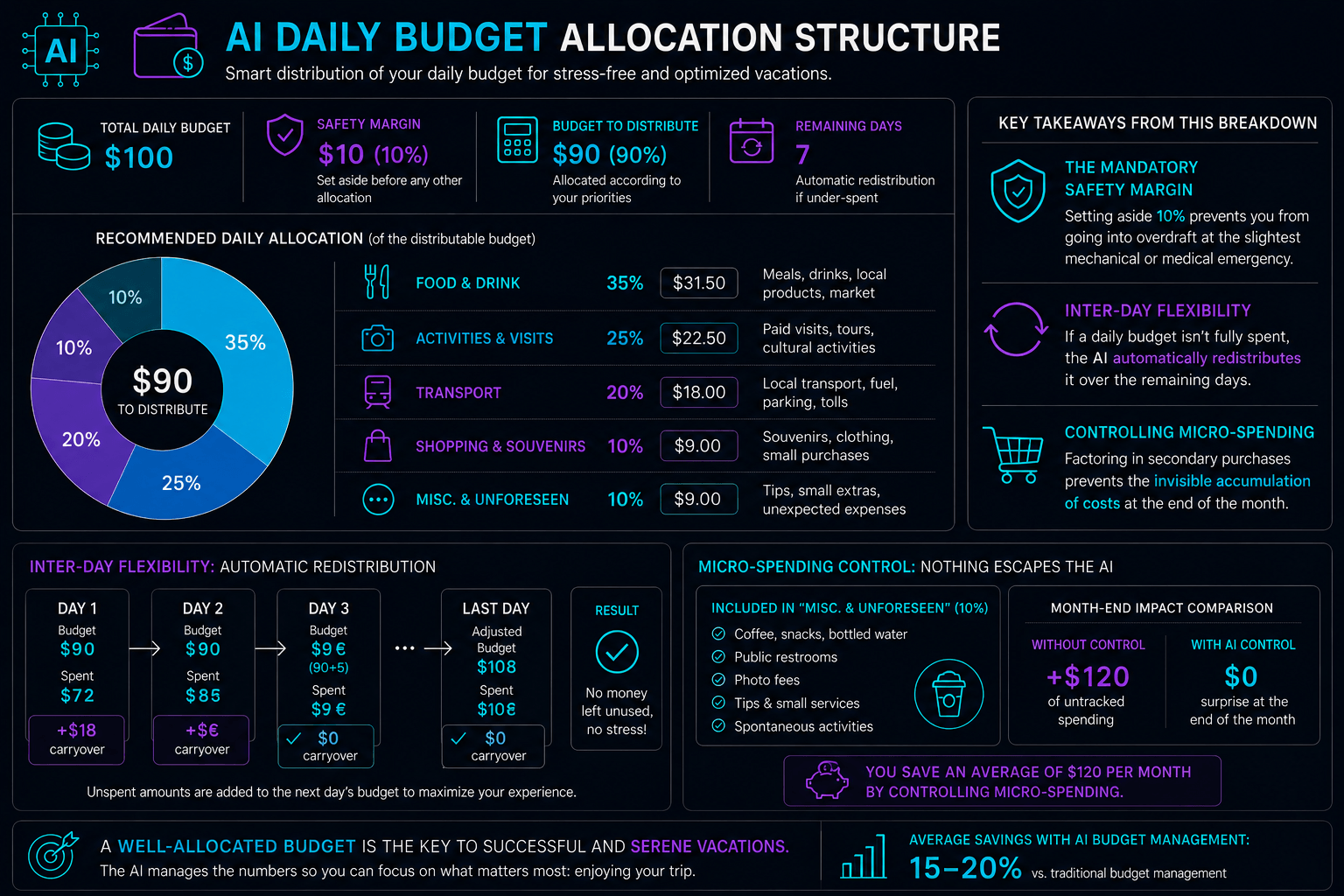
AI Daily Budget Allocation Structure
The chart below details the recommended distribution of a daily vacation budget after deducting the safety margin.
Key Takeaways from This Financial Breakdown
- The mandatory safety margin: Setting aside 10% prevents you from going into overdraft at the slightest mechanical or medical emergency.
- Inter-day flexibility: If a daily budget isn’t fully spent, the AI automatically redistributes it over the remaining days.
- Controlling micro-spending: Factoring in secondary purchases prevents the invisible accumulation of costs at the end of the month.
Optimizing Mobility and Spotting Price-Capped Fuel
To reduce transport costs, you can use AI to compare the actual cost of a car trip against public transport, while locating gas stations that apply price caps. Fuel is a major expense that weighs heavily on household budgets. According to the American Automobile Association (AAA), 2023, 59% of Americans stated that gas prices would impact their summer travel plans. Furthermore, 26% indicated that these prices would cause them to choose a closer destination. Fortunately, there are on-the-ground solutions to limit the blow at the pump.
Optimizing Your Travel Expenses on the Road
For instance, the TotalEnergies group has extended its price cap of €1.99/L for both gasoline and diesel across its 3,300 French stations until the end of 2024. To make the most of these opportunities, I ask ChatGPT to design an optimized road itinerary, instructing it to identify participating stations along my route. At the same time, AI makes it possible to calculate whether using a personal car remains cost-effective compared to local public transport. By feeding it the number of travelers and planned trips, it provides a cost estimate. Sometimes, buying a local weekly transit pass turns out to be far cheaper than paying daily for congested parking lots.
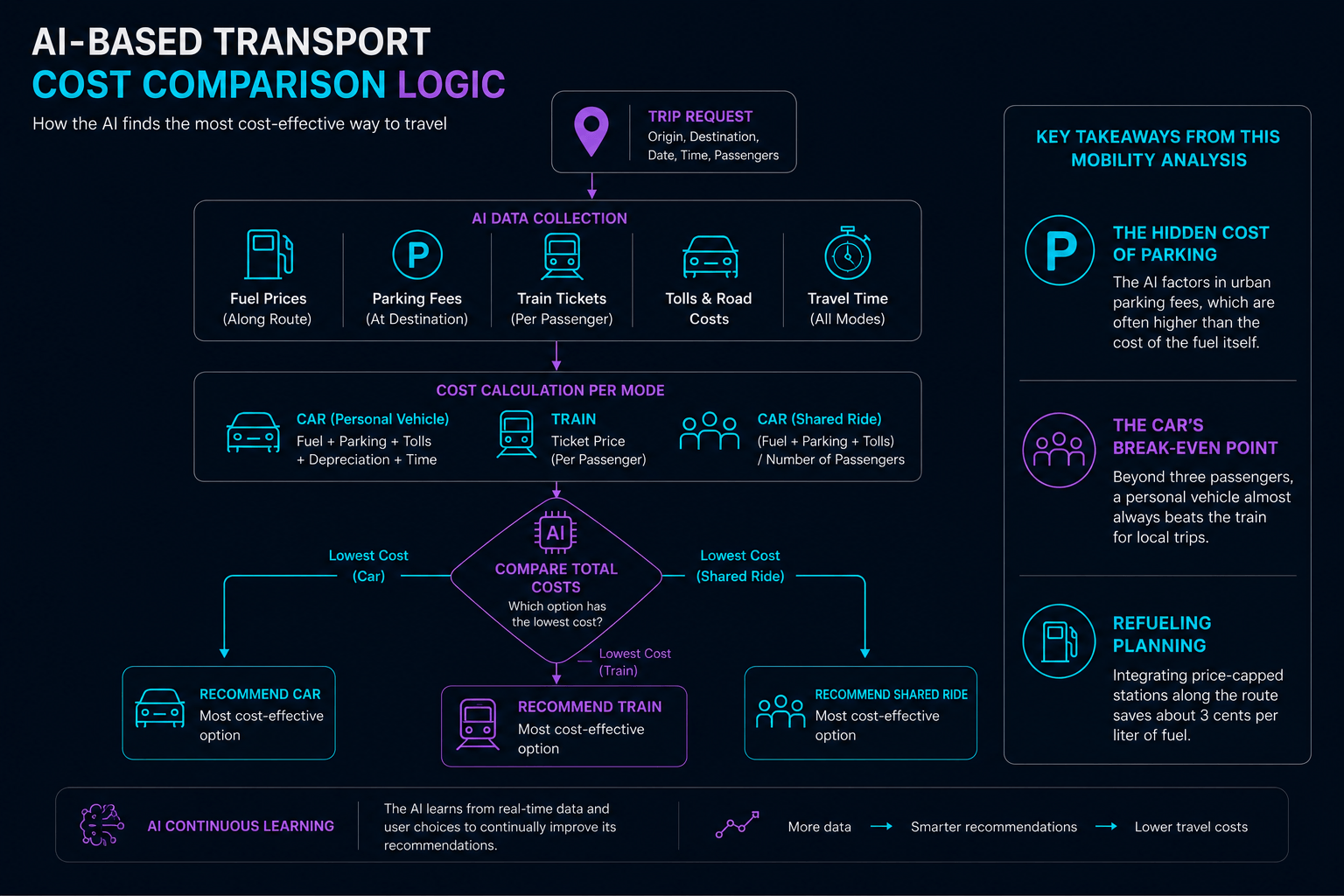
AI-Based Transport Cost Comparison Logic
This decision diagram shows how the AI processes data to determine the most cost-effective mode of transport for a trip.
Key Takeaways from This Mobility Analysis
- The hidden cost of parking: The AI factors in urban parking fees, which are often higher than the cost of the fuel itself.
- The car’s break-even point: Beyond three passengers, a personal vehicle almost always beats the train for local trips.
- Refueling planning: Integrating price-capped stations along the route saves about 3 cents per liter of fuel.
💡 Our Tech Analysis:
Using ChatGPT to optimize your vacation spending isn’t a magic bullet, but a formidable decision-making tool. Its strength lies in its ability to structure complex data (like matching grocery lists with equipment constraints or calculating travel cost-effectiveness). However, users must remain vigilant against the AI’s temporal hallucinations, particularly regarding restaurant addresses or real-time fuel prices. The AI provides a logical structure, but humans must validate real-world data to avoid unpleasant surprises.
Artificial intelligence tools are gradually transforming how we travel and manage our daily finances. By optimizing every expense category, from food to fuel, we can protect our purchasing power without sacrificing our summer enjoyment. It remains to be seen whether the future integration of real-time, ultra-local data will turn these personal assistants into completely foolproof travel companions for our upcoming trips.
Chargement de la galerie…



Creator of IActualité and a rigorous tech tester. With a keen analytical mind and surgical precision, I put AI tools through their paces to deliver practical guides and transparent, unfiltered verdicts. Passionate about Linux, robots, and pop culture!
L'intelligence artificielle, c'est comme un T-Rex dans un parc d'attractions : c'est fascinant à observer, mais il vaut mieux savoir exactement comment la clôture a été codée avant de s'en approcher.



0 Comments