
- A hybrid architecture running locally
- How Apple Intelligence’s hybrid system works
- Using the new Siri on iOS 27 daily
- Siri’s performance against the competition
- Technical and geographical limits of the new Siri on iOS 27
- Global availability of Apple Intelligence
- My expert verdict on this iOS 27 update
- Which devices are compatible with the new Siri on iOS 27?
- Siri in five years: what’s next for the assistant?
- Recommended Reading
🎙️ Tester's Verdict (Audio)
Listen to our final thoughts
A hybrid architecture running locally
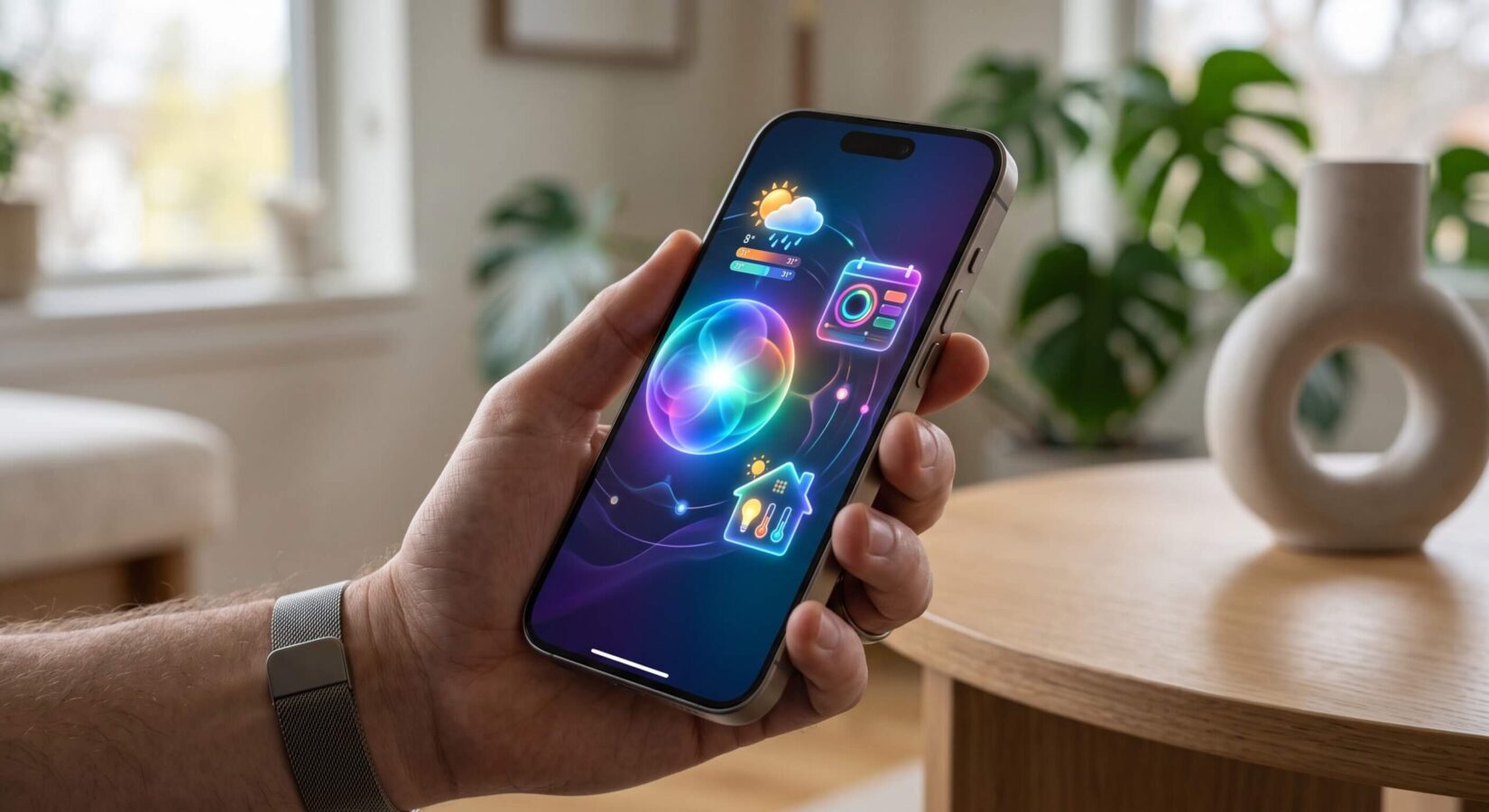
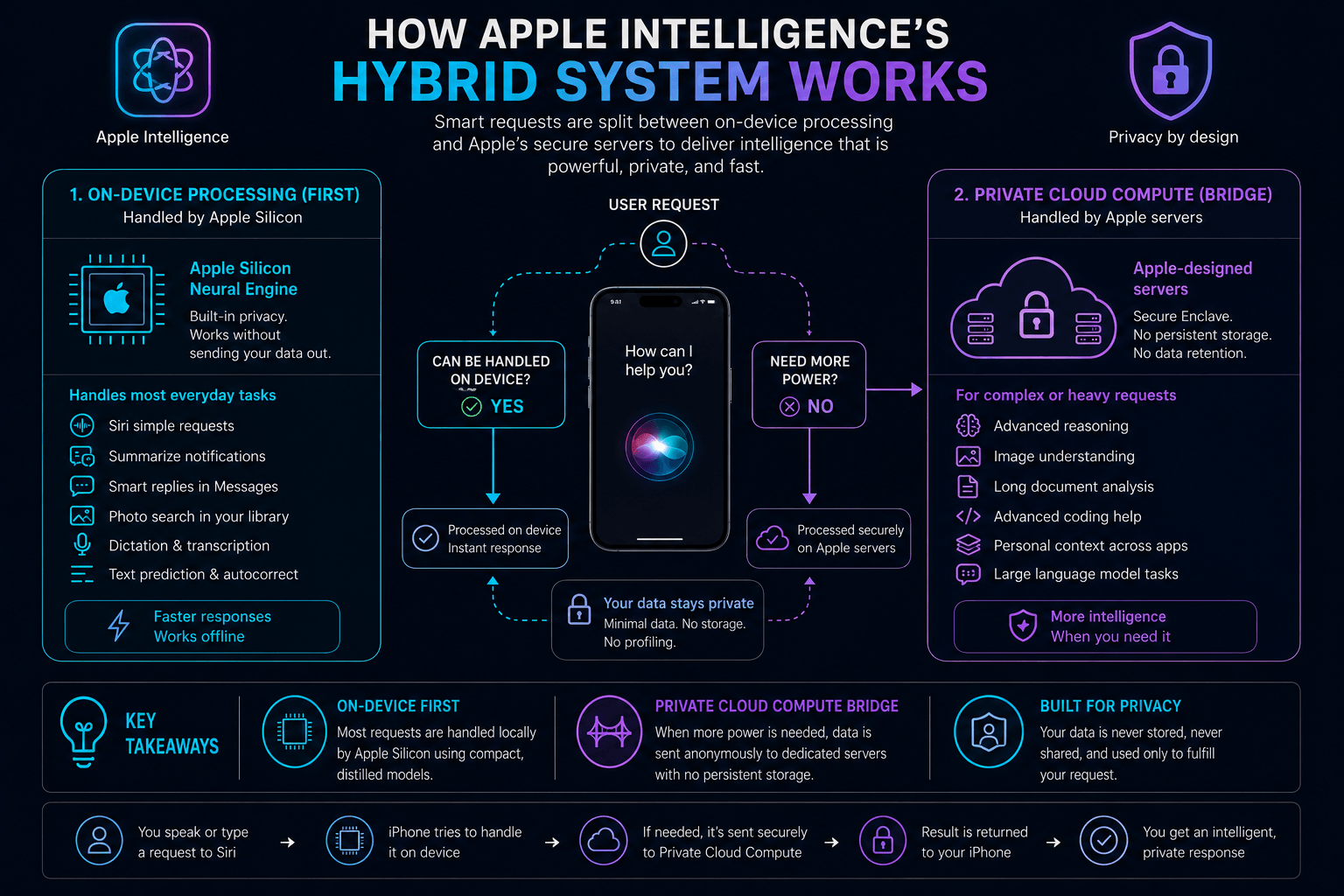
The new Siri on iOS 27 operates on a hybrid architecture that runs lightweight AI models locally on-device while outsourcing complex requests to Apple’s secure Private Cloud Compute. For the first time, AI models are running directly on-device. Apple is leveraging the power of its Apple Silicon chips to power a compact local model. Engineers trained a lightweight model using the knowledge of a larger, heavier large language model. The result is fast and fluid. However, the iPhone can’t handle everything on its own. As soon as a task gets too complex, the system hands it off to Apple’s Private Cloud Compute infrastructure. Apple claims that data is never stored on its servers and remains inaccessible to third parties, protecting our privacy.
How Apple Intelligence’s hybrid system works
Here is how the iPhone splits smart requests between the local processor and Apple’s secure servers.
Key Takeaways from This Data
- On-device processing first: The iPhone’s Apple Silicon chip handles most everyday tasks using compact, distilled models.
- Private Cloud Compute bridge: For heavy requests, data is sent anonymously to dedicated servers with no persistent storage.
The Promise of Absolute Privacy
In practice, this hybrid processing reassures users concerned about personal data. Unlike traditional chatbots that send everything to the cloud, Apple limits this exposure. As a result, I was able to test the tool without worrying about the security of my messages. This is a major advantage over competitors like Google Gemini or OpenAI.
Using the new Siri on iOS 27 daily
Using the new Siri on iOS 27 daily is highly intuitive, as the assistant now understands on-screen context, handles natural phrasing, and offers a dedicated typing interface. Siri finally understands on-screen context. For instance, I asked Siri to find a train schedule sent via text message. The assistant scanned my messages, extracted the info, and added it to my calendar with a single click. It’s a real time-saver. Additionally, voice commands now accept more natural phrasing. You can hesitate or stumble over your words, and Siri corrects itself. On the other hand, the assistant now has a dedicated app. This interface lets you type directly to Siri in a chat-like format-a choice that shows Apple is aligning with ChatGPT’s design cues.
Siri’s performance against the competition
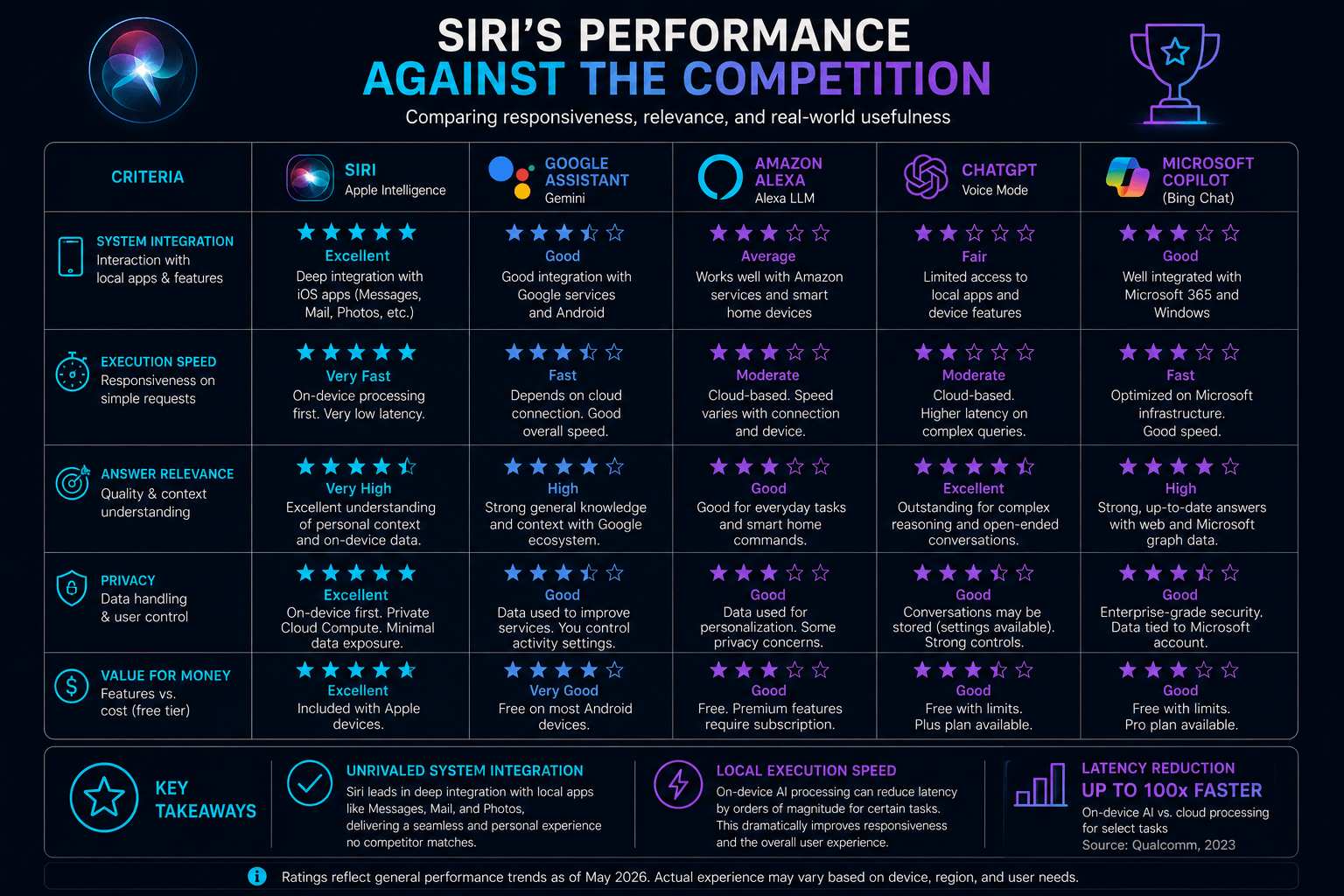
This table compares the responsiveness and relevance of Apple’s new assistant against its direct rivals.
Key Points of the Comparison
- Unrivaled system integration: Siri outperforms competitors when interacting directly with local apps like Messages, Mail, or Photos.
- Local execution speed: According to Qualcomm, 2023, on-device AI processing can reduce latency by orders of magnitude for certain tasks, enhancing responsiveness and user experience.
| Feature / Assistant | Siri (iOS 27) | Google Gemini | ChatGPT (OpenAI) |
|---|---|---|---|
| On-Device Processing | Yes (Local hybrid) | No (Cloud-first) | No (Cloud-only) |
| App & System Integration | Deep (Messages, Mail) | Moderate (Android) | Very Limited |
| Data Privacy Guarantee | High (Private Cloud Compute) | Standard (Cloud data usage) | Standard (Opt-out needed) |
| EU Availability (Beta) | No (Blocked) | Yes | Yes |
Visual Intelligence and the Camera
Visual Intelligence integrates directly with the camera to let you instantly scan your surroundings, retrieve local business reviews, and perform visual searches. By pressing the Camera Control button, I was able to test the Visual Intelligence feature. According to a review published by Mashable in July 2026, this feature lets you get reviews of a restaurant simply by taking a picture of it. In practice, the camera becomes a gateway to local information. This hardware integration is smart. It avoids the need to open a third-party app for a visual search. However, its effectiveness relies heavily on network connection quality when cloud queries are involved.
Technical and geographical limits of the new Siri on iOS 27
The technical and geographical limits of the new Siri on iOS 27 include a complete block in the European Union due to regulatory conflicts, along with occasional beta slowdowns and screen comprehension errors. The main hurdle is geographical availability. Apple Intelligence is blocked in the European Union. According to Apple’s official statement in June 2024, Apple Intelligence features will not be available in the European Union at launch due to regulatory uncertainties with the Digital Markets Act. For my testing, I had to use a US account. This block is due to ongoing regulatory discussions with EU authorities in 2026. Consequently, European users cannot legally test these major features today. This is incredibly frustrating for users in Europe. Furthermore, since this is a beta version, I encountered several slowdowns. Siri occasionally refused to open or misinterpreted screenshots. Some of these hiccups align with complaints on Reddit, where testers reported that the assistant still struggles with basic local tasks, such as failing to retrieve a simple list of contacts messaged the day before.
Global availability of Apple Intelligence
This map highlights the disparities in access to Siri’s advanced features during the beta launch in July 2026.
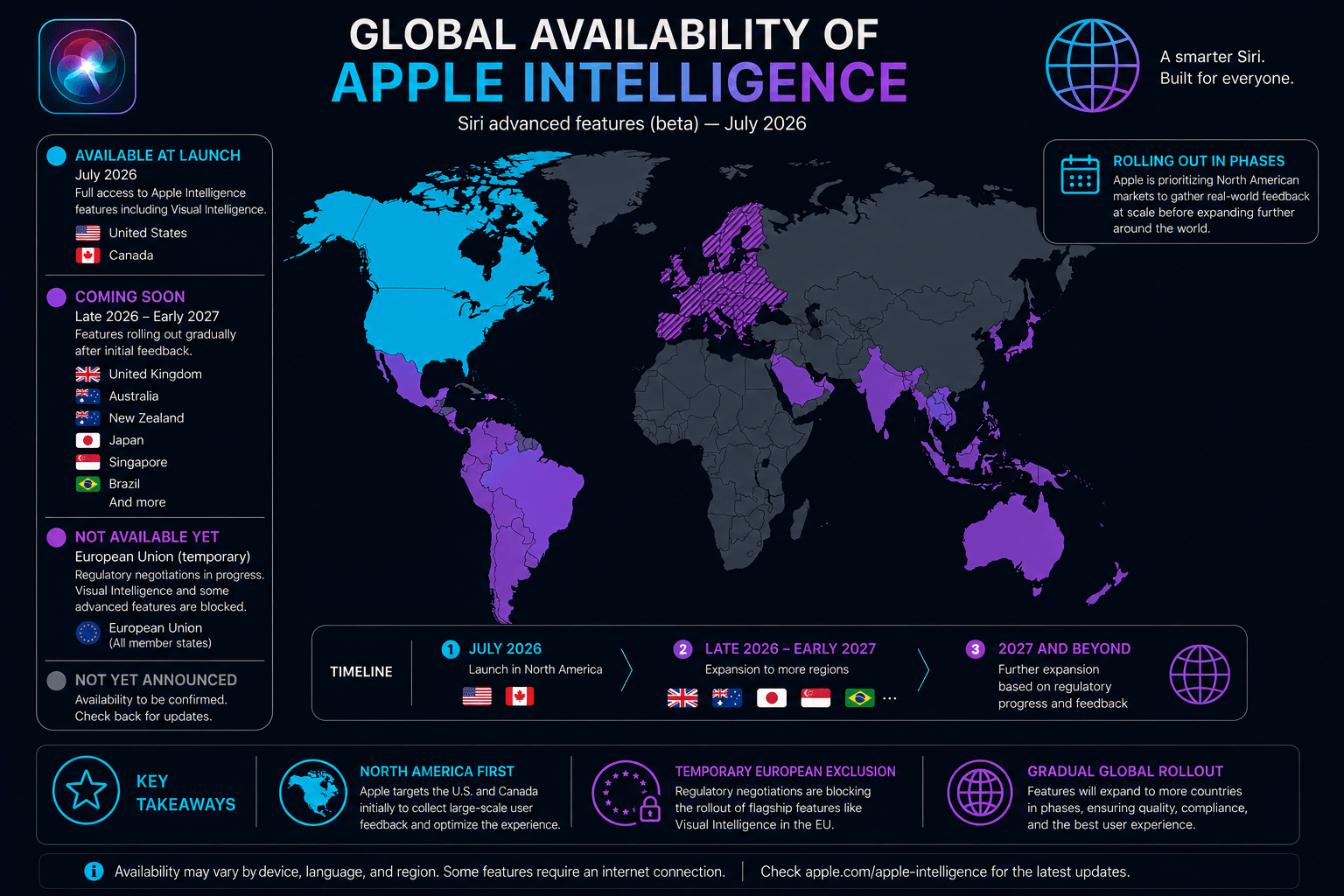
Key Points of Geographical Distribution
- Temporary European exclusion: Regulatory negotiations are blocking the rollout of flagship features like Visual Intelligence in the EU.
- Gradual global rollout: Apple is prioritizing North American markets to gather initial user feedback on a large scale.
Bugs and Comprehension Errors
In practice, I also noticed screen comprehension errors. For example, on a complex webpage with multiple ads, Siri got confused, trying to summarize the ad banners instead of the main text. These hiccups are a reminder that this is still a test version.
My expert verdict on this iOS 27 update
My expert verdict is that iOS 27 successfully elevates Siri into a genuinely useful, privacy-first assistant, though its temporary absence in Europe is a major drawback. This new Siri on iOS 27 is no longer a simple voice gadget. It integrates deeply into our daily workflows, providing real time savings when summarizing emails or automating reminders. One downside: the absence of these features in Europe for the official release scheduled in September 2026 could hurt the brand. European users are paying the same price for a device stripped of its best features. This is a critical issue that Apple needs to address quickly.
💡 Our Tech Analysis:
The new Siri on iOS 27 proves that Apple is prioritizing system integration and privacy over the race for raw computational power. While less creative than ChatGPT Plus, this assistant shines in its ability to interact seamlessly with our local data. Its success will depend on its ability to overcome European regulatory hurdles.
How to Install the iOS 27 Public Beta
To install the iOS 27 public beta, you must sign up for the Apple Beta Software Program, register your device, and download the update through your settings. Simply sign up for Apple’s official program via the Apple Beta Software Program website. After registering your device, the update will appear in your settings. I highly recommend backing up your data to iCloud before getting started.
Which devices are compatible with the new Siri on iOS 27?
To run the new Siri and Apple Intelligence features on iOS 27, you will need an iPhone 15 Pro, iPhone 16 series, or any newer device equipped with an A17 Pro or M-series chip. Older models can run iOS 27 but will remain locked out of these advanced local and cloud-based AI capabilities.
Siri in five years: what’s next for the assistant?
In five years, the very idea of manually controlling our phones will likely seem prehistoric. Assistants like the new Siri on iOS 27 will have evolved into autonomous agents capable of anticipating our needs before we even voice them. We will no longer have to juggle dozens of apps. However, this transition will depend on user trust. If tech giants can prove that our personal data remains secure, adoption will be absolute. Otherwise, these tools will remain limited to advanced gadgets for a handful of tech enthusiasts.
Chargement de la galerie…


Creator of IActualité and a rigorous tech tester. With a keen analytical mind and surgical precision, I put AI tools through their paces to deliver practical guides and transparent, unfiltered verdicts. Passionate about Linux, robots, and pop culture!
L'intelligence artificielle, c'est comme un T-Rex dans un parc d'attractions : c'est fascinant à observer, mais il vaut mieux savoir exactement comment la clôture a été codée avant de s'en approcher.


0 Comments