- In Brief: The Essentials of DALL-E 3
- ⚡ Performance & Limits
- 🧪 Concrete Example: Input vs Output
- 🎯 Is this tool REALLY for you?
- 🤝 Community & Support
- Key Features
- Who is DALL-E 3 for?
- Use Case: Creating Brand-Consistent Social Media Graphics with Integrated Text
- 🟣 PROMPT TEMPLATES FOR DALL-E 3
- Pricing & Plans
- Pro Tips
- ⚠️ Crash Test & Limitations
- What other users are saying
- ⚙️ The Ideal Workflow
- Our Review of DALL-E 3
- 🔗 Integrations & API
- Security & Privacy
- Frequently Asked Questions (FAQ)
- Alternatives Comparison
- Take action: try DALL-E 3 today!
- Top 3 Alternatives to DALL-E 3
🎙️ Tester's Verdict (Audio)
Listen to our final thoughts
In Brief: The Essentials of DALL-E 3
The promise of AI image generation has always been to bridge the gap between imagination and visual reality, often falling short when it comes to nuanced details or accurate text. DALL-E 3, for a significant period, stood as a testament to how far we’d come, particularly in understanding complex prompts. Before its deprecation, it represented a monumental leap from its predecessors, offering a level of intuitive creation directly within conversational interfaces. However, the rapidly evolving landscape means that even groundbreaking tools can quickly become yesterday’s news. While DALL-E 3 set new benchmarks for accessibility and prompt interpretation, its journey has now concluded, paving the way for newer, more capable models. We approached DALL-E 3 not just as a standalone tool, but as a critical piece in the generative AI timeline, assessing its former strengths and current legacy in light of its replacement.
⚡ Performance & Limits
- Learning Curve: 2 hours for basic usage via ChatGPT; 5-10 hours for advanced prompting and API integration.
- Speed: Average 10-20 seconds per image via ChatGPT. API calls varied, with rate limits impacting throughput, making it slower than newer models like GPT Image 1.5 which are 4x faster.
- Free Limits: DALL-E 3 itself did not offer a standalone free plan; it was included with ChatGPT Plus. However, it was accessible for free via Microsoft Copilot. Within ChatGPT Plus, users were often limited to around 40 messages every 3 hours, with image generations counting against this quota.
🧪 Concrete Example: Input vs Output
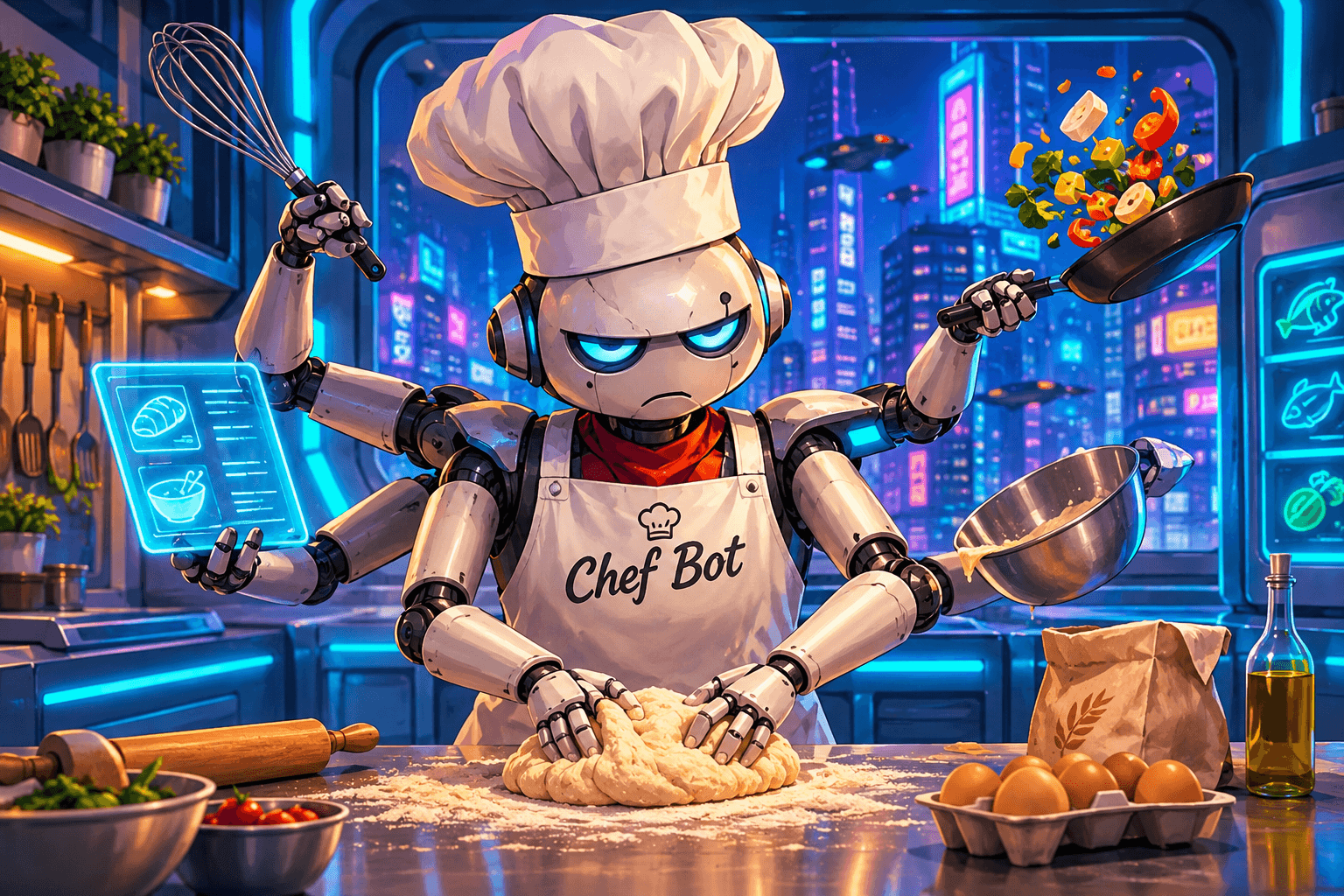
“A whimsical illustration of a grumpy-looking robot chef wearing a tall toque, kneading dough with multiple arms in a futuristic kitchen. The kitchen should have glowing blue accents and a window looking out onto a neon-lit cyberpunk cityscape at night. The robot has ‘Chef Bot’ written on its apron.”
🎯 Is this tool REALLY for you?
✅ YES, use it if:
- You were an early adopter of AI image generation and needed a reliable tool for general content creation and visual ideation with strong prompt adherence.
- You were heavily integrated into the ChatGPT ecosystem and valued conversational, iterative image creation.
- You needed a tool that was proficient at rendering short, legible text within images for marketing or illustrative purposes.
❌ NO, avoid it if:
- You expect the latest in AI image generation technology; DALL-E 3 has been deprecated and superseded by more advanced models like GPT Image 1.5.
- You require advanced in-painting, out-painting, or highly granular image editing capabilities directly within the generation interface, as DALL-E 3’s native editing tools were limited.
- You need consistent artistic flair and unique aesthetic styles for high-end art projects, where competitors like Midjourney often produced more visually striking results.
- You demand the absolute fastest generation speeds and lowest latency, as newer models have surpassed DALL-E 3 in this regard.
🤝 Community & Support
OpenAI provides extensive documentation for DALL-E 3 (and its API) through its developer portal, which is technical but thorough. The OpenAI community forums and Discord channels offered peer-to-peer support and a platform for discussing prompting techniques and troubleshooting. Direct customer support for DALL-E 3 typically fell under the OpenAI/ChatGPT Plus support umbrella, generally responsive but not always personalized for specific image generation issues. With its deprecation, community and direct support will naturally shift towards newer models.
Key Features
- **Prompt Understanding & GPT-4 Integration**DALL-E 3’s standout feature was its exceptional ability to interpret highly complex, multi-part prompts with remarkable accuracy. Unlike its predecessors and many competitors at the time, it rarely ignored elements or misinterpreted relationships between objects in a prompt. This was largely thanks to its native integration with GPT-4, which acted as a ‘prompt whisperer,’ automatically enhancing and rewriting vague user inputs into much more detailed and descriptive paragraphs that the image model could better understand. This behind-the-scenes refinement meant users didn’t need extensive prompt engineering skills to achieve good results, making the tool incredibly accessible.
- **Improved Text Rendering**For a long time, generating legible text within AI-created images was a significant challenge for all models. DALL-E 3 made substantial progress in this area, reliably rendering short phrases and words with high accuracy (benchmarks placed it around 92%). This capability opened up new use cases for graphic design, marketing, and creating visuals that required integrated textual elements like signs, logos, or posters. While it still struggled with complex typography or longer text blocks, its performance was superior to many contemporaries and a clear improvement over DALL-E 2.
- **High-Quality Image Generation & Style Versatility**DALL-E 3 consistently produced high-quality, often photorealistic images with impressive detail, accurate lighting, and proper perspective. It demonstrated significant versatility in generating images across a wide range of artistic styles, from oil paintings and watercolors to digital art, 3D renderings, and even surreal concepts. While some critics found its default aesthetic somewhat ‘conservative’ compared to Midjourney’s more adventurous outputs, DALL-E 3’s reliability in adhering to the prompt and producing clean, usable visuals was a major practical benefit, especially for commercial applications.
- **Seamless ChatGPT Integration**The native integration with ChatGPT was a game-changer for user experience. Instead of a separate, rigid interface, users could converse with ChatGPT, describing their vision in natural language. This conversational approach allowed for iterative refinement; users could ask ChatGPT to make tweaks, add elements, or change styles with simple follow-up requests. This made DALL-E 3 incredibly intuitive, turning complex image generation into a fluid, dialogue-driven creative process, democratizing access to AI art for a much broader audience beyond professional designers.
Who is DALL-E 3 for?
Use Case: Creating Brand-Consistent Social Media Graphics with Integrated Text
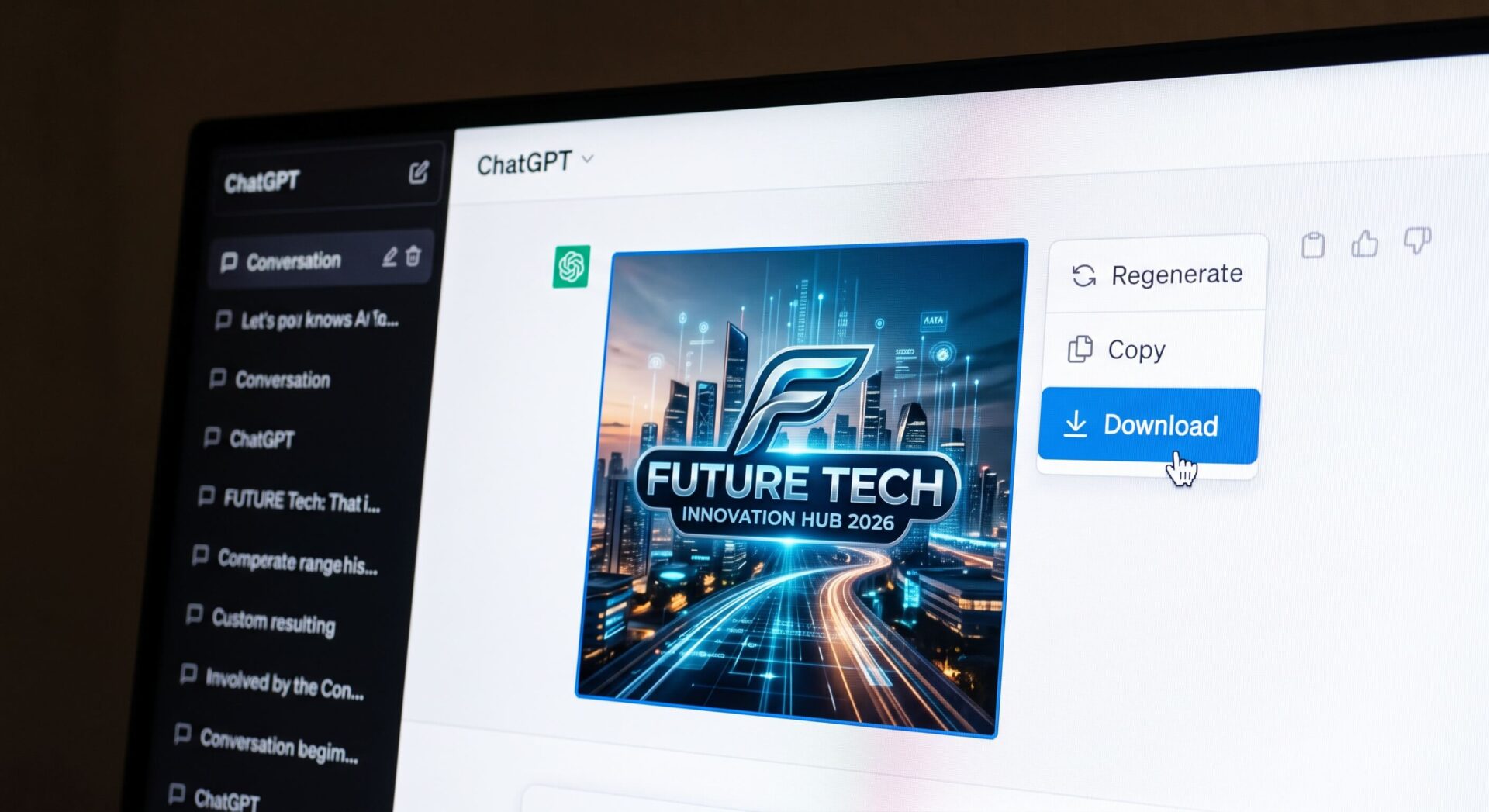
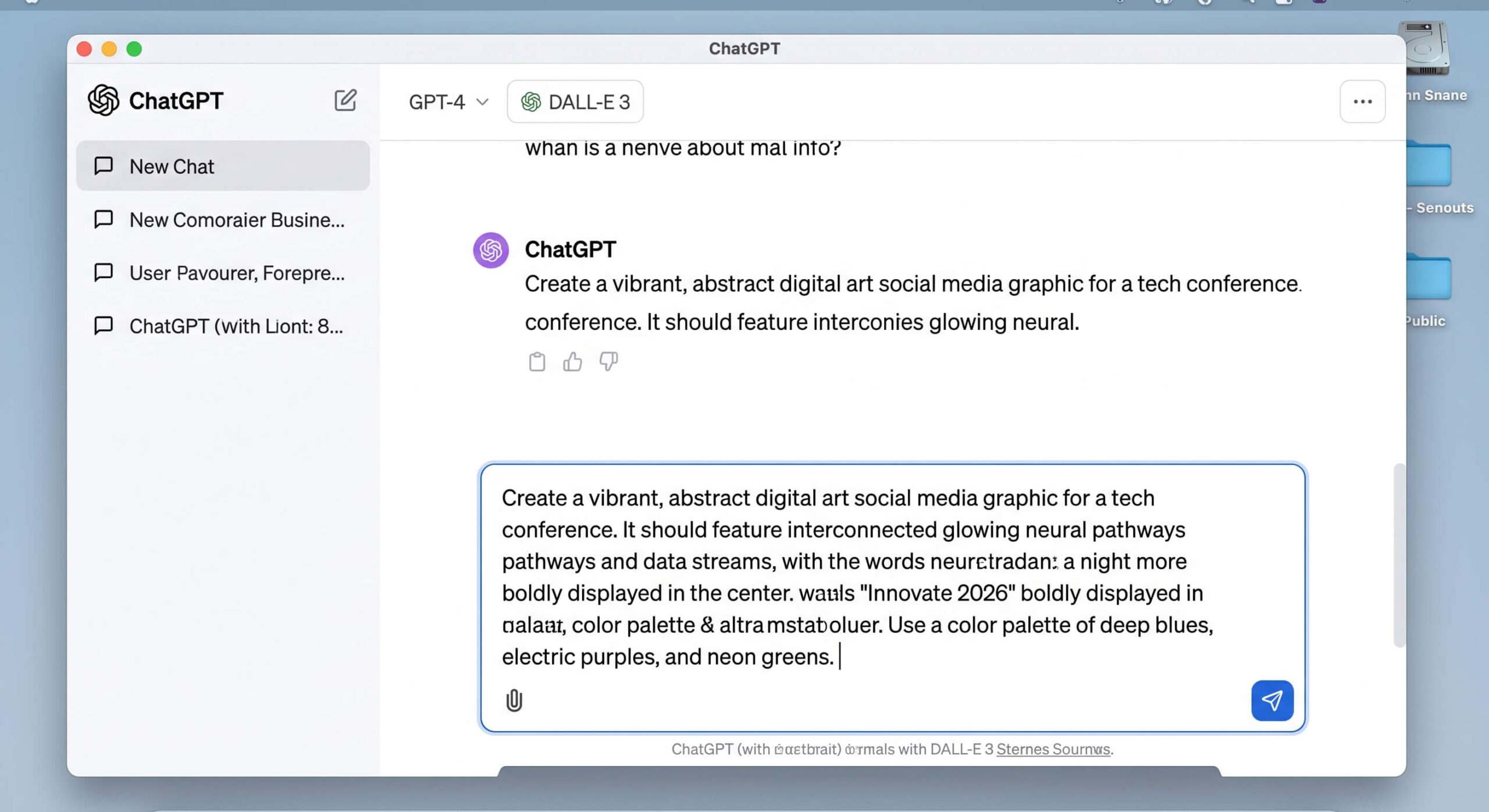
- Step 1. Initial Concept & Prompting in ChatGPT: Open ChatGPT (with DALL-E 3 enabled). Describe your desired social media graphic, including the overall theme, key elements, and *the exact text* you want to appear. For example: ‘Create a vibrant, abstract digital art social media graphic for a tech conference. It should feature interconnected glowing neural pathways and data streams, with the words “Innovate 2026” boldly displayed in the center. Use a color palette of deep blues, electric purples, and neon greens.’
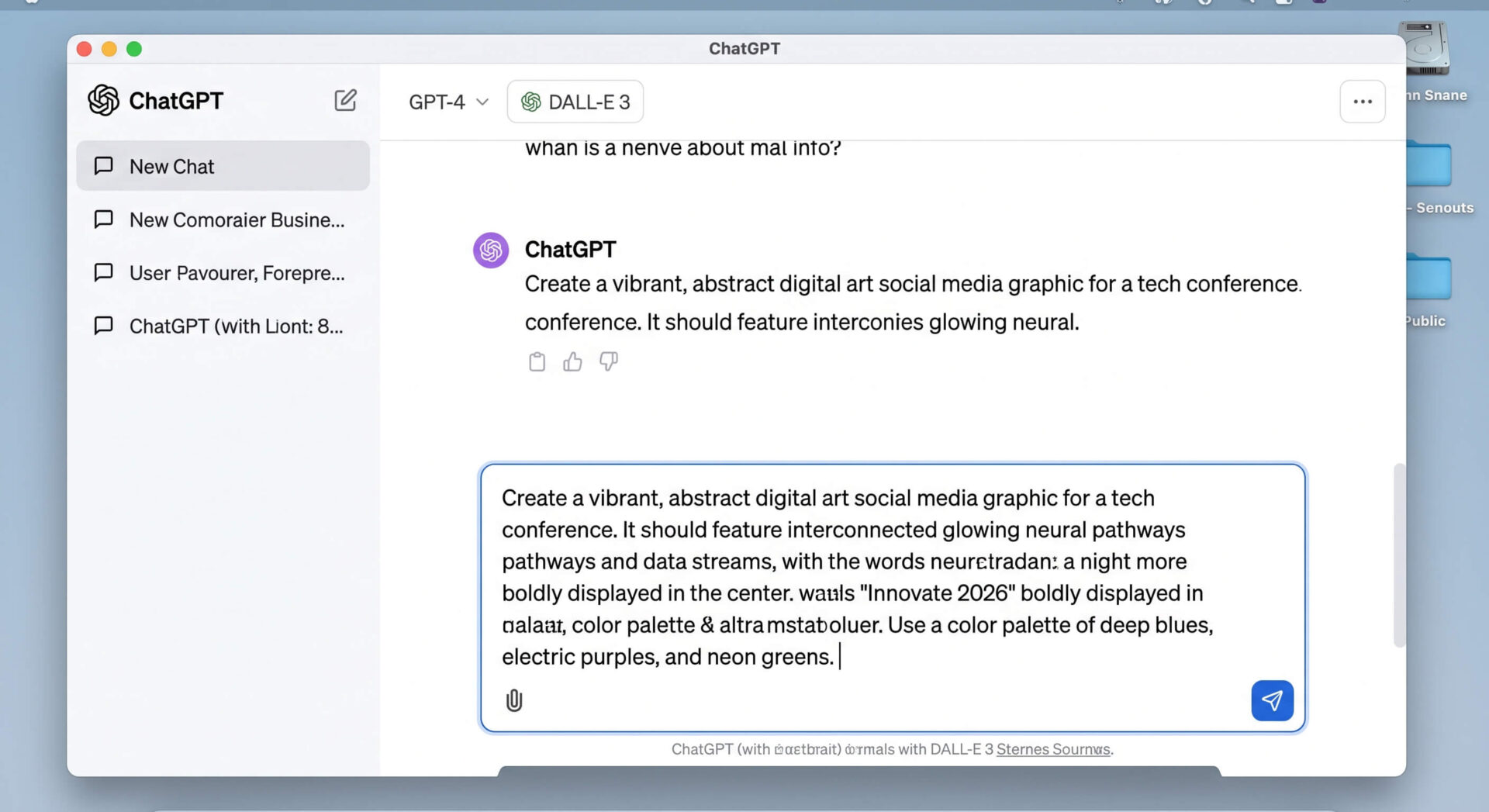
Une démonstration de DALL-E 3 intégré à ChatGPT, capable de transformer des descriptions textuelles détaillées en concepts visuels pour événements tech. - Step 2. Reviewing and Iterating: DALL-E 3 will generate initial variations based on your prompt. Critically assess the prompt adherence, visual quality, and especially the legibility and placement of the text. If the text is slightly off or the colors aren’t quite right, use conversational follow-up prompts like ‘Make the text “Innovate 2026” larger and more metallic,’ or ‘Adjust the background to be less cluttered and focus more on the glowing pathways.’
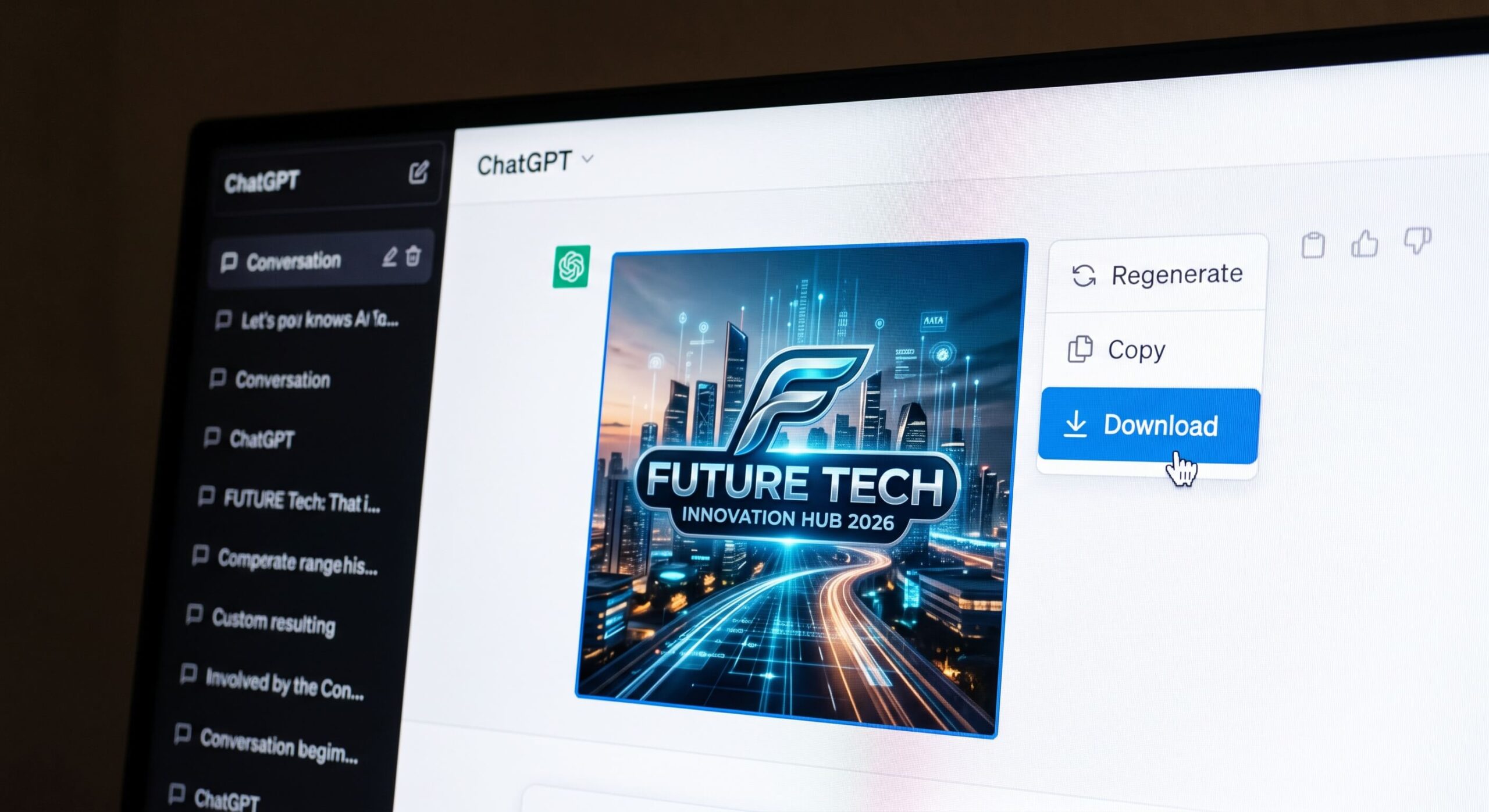
- Step 3. Selecting and Downloading: Choose the image variation that best fits your brand and message. Download the high-resolution image directly from the ChatGPT interface.
L’interface de ChatGPT présentant une création DALL-E 3, illustrant la capacité de l’IA à générer des visuels complexes et prêts à l’emploi. - Step 4. Post-Processing for Branding (Optional but Recommended): Import the downloaded image into a dedicated graphic design tool like Adobe Photoshop or Canva. Here, you can add your company’s official logo, precise brand fonts for additional text elements (if needed), or fine-tune colors to match exact brand guidelines.
🟣 PROMPT TEMPLATES FOR DALL-E 3
Here are some optimized prompt examples:
Editorial Illustration with Specific Text
Product Concept Art
Surreal Landscape with Artistic Style
Pricing & Plans
DALL-E 3 was primarily accessed via a ChatGPT Plus subscription at $20/month, which included its usage without additional per-image charges, though it was subject to conversational rate limits. For developers, it was available through the OpenAI API on a pay-as-you-go model, with prices starting at $0.04 for a 1024×1024 standard quality image, and up to $0.12 for a 1792×1024 HD image. While some third-party platforms offered DALL-E 3 at varying prices, the OpenAI API provided direct access with options for ‘HD’ quality and ‘vivid’ or ‘natural’ styles not directly exposed in the ChatGPT interface. Critically, free access to DALL-E 3 was available through Microsoft Copilot. However, with DALL-E 3 now deprecated, these pricing structures are largely historical, replaced by the models that succeeded it.
Pro Tips
Pro Tips
- 01
TIP
Even when using the ChatGPT interface for DALL-E 3 (or its successors), be explicit and detailed in your initial prompt, as ChatGPT will still build upon your input. Specify style, mood, lighting, and camera angles.
- 02
ADVICE
For text within images, keep phrases short and use quotation marks to ensure DALL-E 3 renders them accurately. Specify placement and style (e.g., ‘a vintage sign reading “Open 24/7″‘).
- 03
PRO TIP
Leverage the conversational nature of the ChatGPT integration: ask for iterative refinements like ‘Make the lighting softer,’ ‘Change the background to a forest,’ or ‘Show me more variations of the third image.’
- 04
PRO TIP
Experiment with the ‘vivid’ and ‘natural’ style parameters available via the API for DALL-E 3 (or its successors) to control the output’s dramatic flair or realism.
⚠️ Crash Test & Limitations
Our crash test reveals that while DALL-E 3 was a powerhouse for its time, it wasn’t without its glaring flaws. The most critical limitation is its current status: deprecated as of May 12, 2026, replaced by GPT Image 1.5 within ChatGPT. During its active phase, while its prompt understanding was phenomenal, it struggled significantly with precise spatial awareness, often misplacing objects or distorting relative positions when given complex instructions like ‘a red cube to the left of a blue sphere’. Human anatomy, particularly hands, remained an Achilles’ heel, frequently resulting in distorted or unrealistic depictions. Furthermore, despite improvements in text rendering, longer phrases or intricate typography often became garbled or nonsensical. The reliance on GPT-4’s internal prompt rewriting, while beneficial for ease of use, simultaneously removed a layer of direct user control, sometimes leading to outputs that deviated subtly from the original intent without clear user intervention options.
What other users are saying
Our review is first and foremost a hands-on take, but it's worth checking it against what other users report elsewhere on the web.
Reddit — Users experienced a mixed, often nostalgic, sentiment towards DALL-E 3, initially praising its creativity and 'personality' but later feeling a decline in quality and variety, expressing frustration over its discontinuation for unique art styles. View source
Capterra — Generally positive reviews highlight DALL-E 3's user-friendliness, ability to generate creative, high-quality images from complex descriptions, and seamless integration with ChatGPT, though some note occasional struggles with fine details or text. View source
G2 — Users appreciate DALL-E 3's ease of use and quick transformation of text prompts into detailed images, especially with ChatGPT integration, but criticize its occasional struggles with complex prompts, generation speed, and output inconsistency compared to Midjourney's artistic polish. View source
Our take : These external signals collectively offer a nuanced user perspective, confirming DALL-E 3's strengths in prompt interpretation and usability, while also highlighting evolving user sentiment regarding consistency, specific artistic capabilities, and the impact of content moderation—aspects crucial for understanding real-world adoption beyond internal evaluations.
⚙️ The Ideal Workflow
For a perfect workflow that aimed for superior prompt control and advanced editing, DALL-E 3 (or its successors) should be combined with Adobe Photoshop or Affinity Photo for post-generation refinement, layering, and in-painting tasks it couldn’t handle natively. For those seeking highly stylized or artistic outputs, combining its conversational ideation with Midjourney for final aesthetic polish was a powerful strategy. For automation, Zapier integration allowed connecting DALL-E 3 to various applications for triggered image generation.
Our Review of DALL-E 3
Strengths
- Unrivaled prompt understanding and adherence, thanks to GPT-4’s re-prompting, which significantly lowered the bar for entry for non-technical users.
- Superior text rendering capabilities compared to most contemporaries, making it practical for specific commercial and design tasks.
- Seamless, intuitive integration with ChatGPT transformed image generation into a conversational workflow, enhancing accessibility and iterative design.
- Consistent output quality for general-purpose images, providing reliable visuals for a wide array of uses without extensive prompt engineering.
Weaknesses
- DALL-E 3’s deprecation means it’s no longer the leading edge, and users should now look to its successors.
- Lack of direct, fine-grained control over prompt interpretation when used via ChatGPT, as GPT-4’s re-prompting could sometimes lead to unintended interpretations.
- Limited native in-painting and advanced editing features, forcing users to export images for further refinement in other software.
- Generation speed, while good for its time, was slower than newer, dedicated image models, and could experience further delays during peak usage.
- Known inconsistencies in rendering human anatomy, especially hands, and struggles with very precise spatial relationships.
🔗 Integrations & API
Security & Privacy
OpenAI implemented industry-leading content safety systems in DALL-E 3, including robust filtering to prevent the generation of harmful, explicit, or biased content. It was designed to decline requests in the style of living artists to respect intellectual property. User data privacy for images generated via ChatGPT Plus adhered to OpenAI’s standard privacy policies. For API usage, the security and privacy depended on the implementation by the developer, with OpenAI outlining data handling policies. Commercial rights for generated images were included with paid plans like ChatGPT Plus.
Frequently Asked Questions (FAQ)
Given its deprecation, what is the effective replacement for DALL-E 3?
As of May 12, 2026, DALL-E 3 has been deprecated. Its direct successor and replacement within the OpenAI ecosystem is **GPT Image 1.5**, often branded as **ChatGPT Images 2.0**. This newer model offers significant improvements in generation speed, editing capabilities, and a native multimodal architecture for better prompt understanding and consistency.
How did DALL-E 3 handle bias and ethical considerations in image generation?
DALL-E 3 incorporated **ethical safeguards and content moderation systems** to prevent the creation of harmful stereotypes or biased imagery, a common challenge for AI models trained on vast internet datasets. OpenAI designed it to avoid generating images in the style of living artists, aiming to mitigate copyright and ethical concerns. While these measures were significant, like any AI, it could still reflect latent biases from its training data, requiring users to be mindful in their prompting.
Could DALL-E 3 generate vector graphics or edit existing images beyond simple variations?
No, DALL-E 3 primarily generated raster images and did not natively support vector graphics output. While it could generate variations of an image and allow for conversational edits through ChatGPT (like changing colors or composition elements), it lacked advanced in-painting, out-painting, or granular editing tools directly within its interface. For these functions, users typically needed to export the generated image to a dedicated graphic design or image editing software.
Alternatives Comparison
| Tool | Ideal For | Starting Price | Free Version | Global Score |
|---|---|---|---|---|
| Midjourney V8 | Professional-grade artistic, stylized, and cinematic visuals with high aesthetic quality and consistent style. | $10-$120/month | No (free access discontinued in 2024) | 9.2 |
| GPT Image 1.5 / ChatGPT Images 2.0 | Seamless integration within ChatGPT, ease of use, conversational editing, and superior overall performance (as DALL-E 3’s successor). | Included with ChatGPT Plus ($20/month) | No (requires ChatGPT Plus) | 9.0 |
| Stable Diffusion 3.5 | Maximum control, customization (via LoRAs, ControlNet), local deployment for data privacy, and high-volume, cost-effective generation for technically proficient users. | Free (open-source, requires GPU investment) | Yes (open-source) | 8.8 |
| Adobe Firefly 3 | Commercial safety, brand-safe content, integration with Adobe Creative Cloud ecosystem, and robust editing tools for existing Adobe users. | Included with Creative Cloud subscriptions | Limited free tier / trial | 8.5 |
| Ideogram 3 | Exceptional accuracy in rendering legible text within images, complex typography, and precise placement for marketing and poster designs. | Various plans (often credit-based or freemium) | Yes (with limits) | 9.1 |
| Flux 2 | Cutting-edge photorealism, natural lighting, and high-quality skin textures, often considered the benchmark for realistic outputs. | Free / Pay-as-you-go / API | Yes (open-weights / free tier) | 9.3 |
Take action: try DALL-E 3 today!
Ready to see what DALL-E 3 can really do for you? Give it a try and judge the results for yourself.
Top 3 Alternatives to DALL-E 3
 Paid
PaidMidjourney
10 to 120 $/monthMidJourney is one of the most powerful and popular AI image generators on the market. Its advanced artificial intelligence allows you to create realistic, original, and artistic visuals from simple text descriptions.

Creator of IActualité and a rigorous tech tester. With a keen analytical mind and surgical precision, I put AI tools through their paces to deliver practical guides and transparent, unfiltered verdicts. Passionate about Linux, robots, and pop culture!
L'intelligence artificielle, c'est comme un T-Rex dans un parc d'attractions : c'est fascinant à observer, mais il vaut mieux savoir exactement comment la clôture a été codée avant de s'en approcher.


0 Comments