



- The Art of Digital Conversation: When Words Transform AI into a True Partner
- Deconstructing the Prompt: The Four Pillars for Surgical Interaction
- Breaking Down Complexity: An Overview of the 4 Pillars of Effective Prompting
- Beyond Simple Commands: Advanced Techniques Redefining Performance
- Unveiling the Reasoning: When AI Thinks Aloud with Chain-of-Thought
- Chain-of-Thought: From Problem to Articulated Solution
- Embracing a Role, Defining a Framework: Persona and Template for Coherence
- The Invisible Guardrails: The Art of Negative Constraints and Iterative Refinement
- The Real Technical Limit: AI Still Can’t Read Our Minds (And That’s a Good Thing)
- Towards a Human-Machine Symphony: The Future of Prompt Engineering
🎙️ Tester's Verdict (Audio)
Listen to our final thoughts
The Art of Digital Conversation: When Words Transform AI into a True Partner
This initial disappointment is something I’ve shared with many. AI promised wonders, yet in daily use, it often fell short of our expectations. The problem, I quickly realized, wasn’t with the models themselves, but with the fundamental lack of sophisticated prompt design and the art of effectively guiding AI. What we call “prompt engineering” isn’t a niche skill reserved for engineers; it has become the cornerstone of fruitful interaction with any generative artificial intelligence. It’s the key that transforms a simple text generator into a true copilot, capable of understanding and executing complex tasks with astonishing precision. More strikingly, according to a Google AI blog post, 2023, integrating techniques like “chain-of-thought” has been shown to improve reasoning performance by 40 to 70% on complex tasks.
These figures are not anecdotal; they underscore a simple truth: investing time in mastering the art of the prompt ensures maximum return on investment from every AI interaction. It’s the difference between an intern who waits for every word to be dictated, and a collaborator who anticipates, analyzes, and produces quality work, provided they’re given the right directives. AI doesn’t read our minds. It doesn’t guess our implicit intentions or the context of our request. It merely processes the words we submit and generates the most probable continuation, based on billions of data points. This is why formulation is critical. A vague prompt will inevitably produce a generic, bland response, while a precise prompt will pave the way for a targeted, useful, and often surprising answer. Imagine ordering at a restaurant. Saying “bring me something good” is a lottery. Asking for “a porcini mushroom risotto, al dente, no parmesan” guarantees a result that matches your desires. AI is that excellent chef, provided you master the language of the kitchen.
Deconstructing the Prompt: The Four Pillars for Surgical Interaction
An effective prompt isn’t born of chance but of methodical construction, a cornerstone of AI Prompt Engineering. Through my experiments, like many experts, I’ve identified four fundamental pillars that, when mastered, radically transform the quality of interactions by enabling us to effectively deconstruct prompts and refine their prompt design. It’s not always necessary to use all of them, but the more you enrich your instruction, the more relevant and aligned with your expectations the response will be. It’s akin to adjusting the settings of a professional camera: each parameter contributes to the final image.
1. The Role: Who is the AI in this story?
Assigning a role to the AI gives it a personality and a perceptual filter, a technique known as persona prompting. By telling it “You are a senior Python developer” or “You are a computer science professor for beginners,” you effectively guiding AI not only in its vocabulary and tone but also in the depth and angle of the response. The former will give you optimized code and pointed technical explanations, the latter a pedagogical and accessible tutorial. This simple preamble allows the AI to activate a set of specific knowledge and behaviors, thereby refining its performance. I’ve personally seen a qualitative leap by asking the AI to act as a “digital marketing strategist specialized in SMEs” for brainstorming sessions, with the tone and suggestions immediately becoming more relevant and grounded in the reality of small businesses.
2. The Context: What’s the situation?
The context is the backdrop to your request. It provides the AI with all the necessary information to personalize its response. Who are you? What is your objective? What are your constraints, resources, target audience? The richer and more detailed the context, the better the AI can tailor its response. For example, if I ask it to draft a communication plan, the response will be much better if I specify that “I am the founder of a green technology startup, my goal is to raise funds within 6 months, and my audience consists of investors concerned with social and environmental impact.” This level of detail allows the AI to weave a bespoke response, avoiding sterile generalities.
3. The Format: What form should the response take?
Form is just as important as substance. Without format indication, AI will often default to a continuous text paragraph, which isn’t always what you expect. Do you want a bulleted list, a table, code, an email, a detailed plan, a dialogue? Specifying the format avoids unpleasant surprises and saves valuable time in post-editing. When creating tool comparisons, for instance, imposing a table format with specific columns (Name, Advantages, Limitations, Price) allowed me to obtain structured and instantly usable data.
4. The Constraints: What are the limits?
Constraints are the guardrails of AI’s creativity. They channel its output and eliminate irrelevant results. Maximum length, desired tone (formal, casual, expert), elements to absolutely include, or conversely to formally exclude, target audience, language: each constraint refines the response. Not wanting technical jargon, requiring simple language, or prohibiting price mentions are all examples of constraints that guarantee a relevant response for the intended use. It is by combining these four pillars that one moves from a haphazard interaction to a precise and effective command, as demonstrated by the classic example of a follow-up email, transformed from a vague “Write a professional email” into a detailed and actionable instruction.
Breaking Down Complexity: An Overview of the 4 Pillars of Effective Prompting
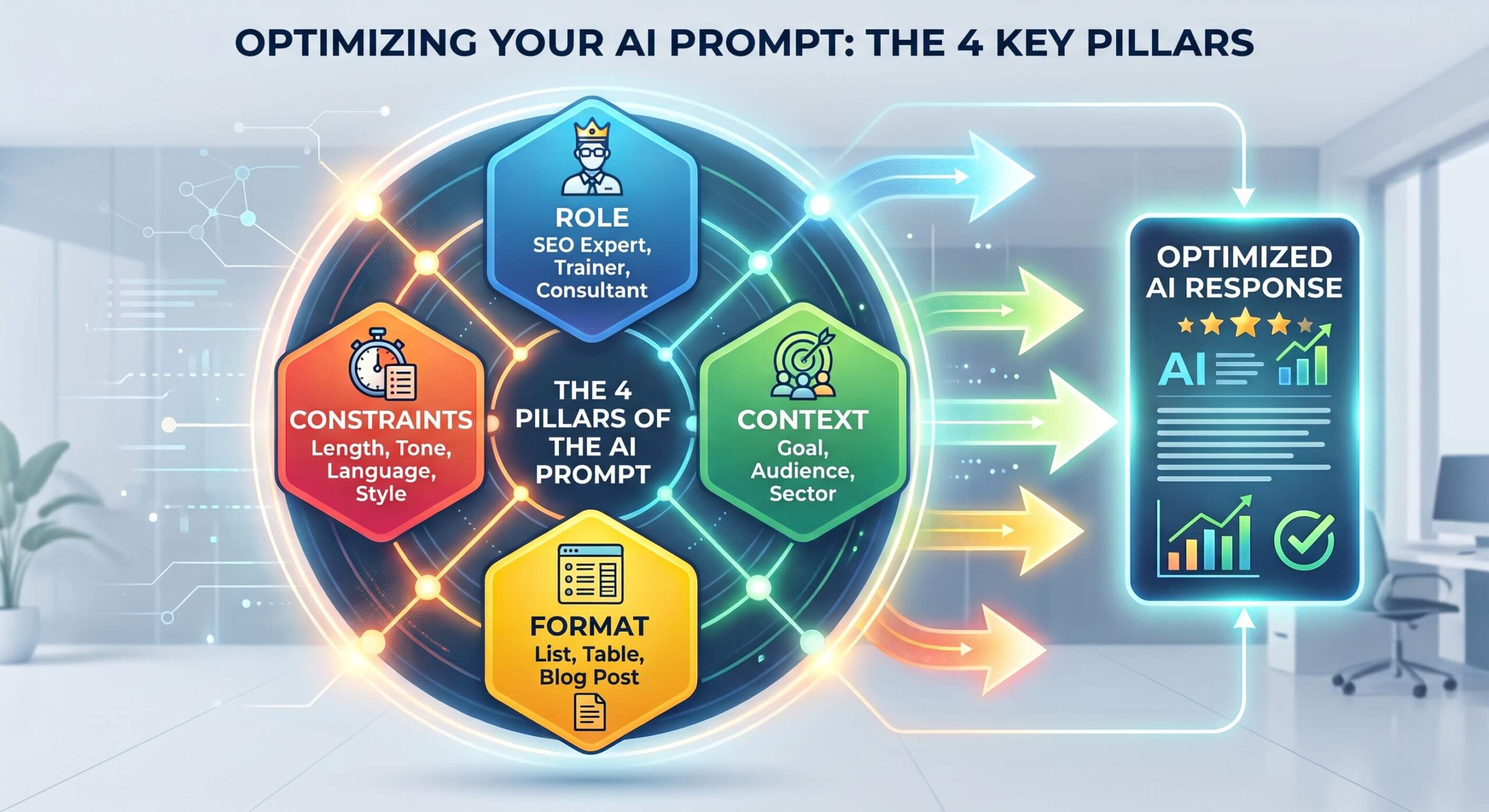
To better visualize the interaction between these different components, I’ve prepared a diagram that condenses the philosophy of prompt engineering.
Key takeaways from the diagram
- The Role (Persona): The foundation of the AI’s personality and expertise, determining its response angle.
- The Context (Situation): Vital information that anchors the request in a specific reality, avoiding generalities.
- The Format (Structure): The expected presentation of the response, crucial for integration into an existing workflow.
- The Constraints (Limits): Strict rules that guide generation, ensuring content relevance and compliance.
Beyond Simple Commands: Advanced Techniques Redefining Performance
Once the pillars are mastered, it’s time to explore advanced “prompt engineering” techniques that can exponentially boost AI’s effectiveness. These methods, used by professionals, work on most large language models, from ChatGPT to Gemini, Claude, and Mistral. They represent a true arsenal for refining your queries and obtaining results of unparalleled quality, transforming AI from a simple executor into a valuable collaborator. It’s like upgrading from a basic toolkit to a complete workshop.
1. Zero-shot and Few-shot: Learning by example
“Zero-shot prompting” is the most intuitive technique: you ask a direct question without providing an example. It excels for common tasks and factual questions, especially with the latest models like ChatGPT-4 or Claude 3.5. If I ask “Categorize these words into two groups: fruits and vegetables,” the AI, leveraging its massive training, executes without difficulty. This is the basic, simple request, but often sufficient for clear needs. Simplicity is sometimes the best strategy, provided the task is intrinsically simple. “Few-shot prompting,” on the other hand, is a true masterclass in teaching AI by example. By providing two to five examples of the expected outcome, you show it the “pattern” you want it to reproduce. This is particularly effective for achieving a specific tone, style, or format.
If you want product descriptions with a specific structure, you give two examples, then the AI generates the third based on this model. “Write product descriptions following this pattern: Product: Wireless headphones. Description: Crystal-clear sound, 30h battery life, active noise cancellation. Your concentration bubble, wherever you are. €89. Product: Compact mechanical keyboard. Description: Silent tactile switches, RGB backlight, 75% format. The precise typing that makes the difference. €129. Now, write the description for: Vertical ergonomic mouse, price €59.” This method is remarkably reliable for standardizing serial productions or imbuing the AI with a particular stylistic identity. It allows you to bypass the limitations of purely textual instructions by concretely showing what you expect, much like a designer showing a mood board rather than describing every detail.
Unveiling the Reasoning: When AI Thinks Aloud with Chain-of-Thought
Among all prompt engineering techniques, “Chain-of-Thought” (CoT) is undoubtedly one of the most fascinating and powerful. It involves asking the AI to reason step-by-step before delivering its conclusion. The simple addition of a phrase like “Reason step-by-step” or “Break down your analysis” forces the model to deconstruct the problem, articulate its internal thought process, and drastically reduce errors. According to a Google AI blog post, 2023, this technique improves performance by 40 to 70% on mathematical and logical reasoning tasks. It’s somewhat like asking a colleague to explain their thought process rather than just giving you the final answer; you understand better, and errors are easier to identify and correct.
I’ve personally witnessed the effectiveness of CoT on problems that go beyond simple arithmetic. Take a complex project planning scenario. Without CoT, the AI might give you a list of steps without apparent logic. With it, it might begin by “Analyze available resources,” then “Define critical milestones,” “Identify dependencies,” and finally “Propose an adjusted timeline.” Each step becomes a logical building block that constructs the final answer, making the result not only more precise but also more transparent and easily auditable. This is an indispensable technique for all tasks requiring deep analysis, multi-criteria comparisons, or strategic decisions where every argument must be weighed.
Chain-of-Thought: From Problem to Articulated Solution
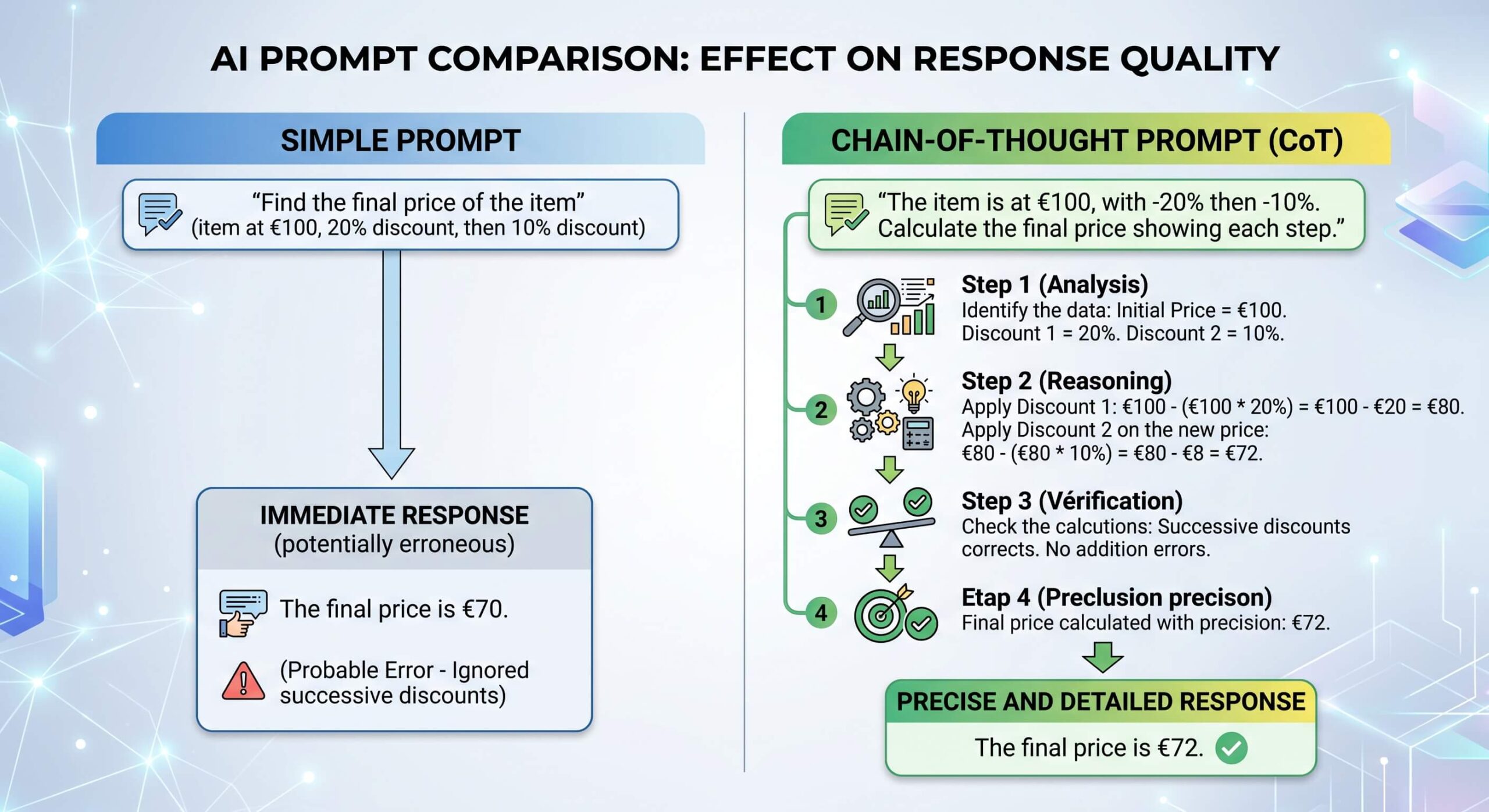
This visual highlights the power of step-by-step reasoning for AI.
What to remember from these data
- Problem Decomposition: CoT forces the AI to segment a complex task into manageable sub-tasks, reducing cognitive load.
- Reasoning Transparency: By articulating each step, the AI makes its decision-making process visible, facilitating human verification and bias identification.
- Error Reduction: Successive validation of intermediate steps significantly minimizes the probability of a final error, especially in logical and mathematical domains.
- Quality Improvement: Responses obtained via CoT are often more complete, better structured, and more reliable, transforming raw data into actionable insights.
Embracing a Role, Defining a Framework: Persona and Template for Coherence
Beyond reasoning, AI’s ability to embody a specific role and adhere to a predefined structure is a strategic asset for many professional uses. Two techniques, “Persona” and “Imposed Template/Format,” are particularly relevant for industrializing content production or obtaining contextualized expert advice. They allow for the surgical sculpting of AI output, transforming a generic model into a tailor-made specialist. The “Persona” technique is an extension of the “Role” pillar we discussed. It’s no longer just about assigning a role but giving the AI a complete professional identity, with its experience, area of expertise, and even positive biases. “You are a senior SEO consultant with 10 years of experience on French e-commerce sites” is not just a simple instruction; it’s an ID card that imbues every word generated by the AI with increased credibility and relevance.
I’ve used this approach to simulate interviews with fictional experts, obtaining strategic analyses that I would have found difficult to extract with a generic prompt. The language level, approach angle, and depth of recommendations change entirely, offering invaluable help for developing strategies or solving complex technical problems. It’s somewhat like delegating a task to a senior colleague rather than a junior; the results are intrinsically different. As for the “Imposed Template/Format” technique, leveraging well-crafted prompt templates is essential for ensuring the homogeneity and structure of content produced in series. If you need product sheets, tool comparisons, analysis reports, or even social media posts, defining a precise template that the AI must fill is an invaluable time-saver for refining AI output consistently.
For example, asking the AI to “Present 3 project management tools following this template for each: Name: [tool name] In one sentence: [15 words max description] Ideal for: [team type/use] Price: [monthly fee] Strong point: [one key advantage] Limitation: [one honest drawback]” allows for standardized production. This ensures not only a consistent presentation but also facilitated extraction of key information for the end-user. This technique is the holy grail of efficiency for anyone looking to industrialize content creation without sacrificing quality or relevance. It’s the guarantee of compliant, infinitely repeatable delivery. It’s important to note that these techniques are not exclusive. Their true power lies in their combination. A prompt that uses a Persona, detailed Context, an Imposed Format, and Negative Constraints will be infinitely more effective than a prompt using only one of these approaches. It’s an orchestra where each instrument plays its part for a perfect symphony.
The Invisible Guardrails: The Art of Negative Constraints and Iterative Refinement
In the world of prompt engineering, it’s not always enough to tell the AI what you want. Sometimes, it’s just as crucial to tell it what you don’t want. This is where the “Negative Constraint” technique comes in, a discreet but powerful guardrail that guides content generation by eliminating clichés, redundancies, or irrelevant information. By specifying “Do NOT start with ‘In a world where…'” or “Do NOT mention price reductions,” you refine the response and make it immediately more relevant and original. I’ve often resorted to this method to avoid boilerplate introductions or overly aggressive commercial phrasing, succeeding in obtaining more nuanced and authentic texts.
However, AI Prompt Engineering is not an exact science mastered on the first try. It’s an “iterative” process, built on trial, error, and constant adjustments aimed at refining AI output. You start with an initial prompt, analyze the AI’s response, then refine your instruction based on the results. It’s a continuous dialogue, a dance where each step improves synchronization. Google Cloud’s best practices for prompt engineering, regularly updated, emphasize the importance of “systematically testing changes” and “recording different prompt attempts” to understand what works best and why. This methodical approach allows for building a library of effective prompts and developing valuable intuition for interacting with models. It’s a skill forged with practice, like a sculptor carving stone, piece by piece, to reveal the desired form.
💡 Our Tech Analysis:
While the promise of prompt engineering is alluring, it conceals a significant learning curve. The subtlety of formulation, the ability to anticipate AI’s reactions, and the patience for iteration are indispensable human qualities. The trap would be to believe that a well-prompted AI is infallible. It remains a tool, powerful certainly, but subject to biases inherent in its training data and reasoning limitations that cannot be fully compensated by prompt engineering alone. We must remain vigilant about hallucinations or responses that, despite clear instructions, may lack nuance or creativity. AI will not replace human judgment; it will augment it.
For those wishing to delve deeper into this discipline, quality resources exist. The “ChatGPT Prompt Engineering for Developers” course from DeepLearning.AI, co-taught by Isa Fulford of OpenAI, is an excellent gateway to understanding best practices and applying them concretely, even for non-developers. Similarly, OpenAI’s official guides and Google Cloud’s best practices offer valuable advice for maximizing the effectiveness of your interactions.
The Real Technical Limit: AI Still Can’t Read Our Minds (And That’s a Good Thing)
Despite spectacular advances in prompt engineering, it’s crucial to keep our feet on the ground and understand a fundamental limit: AI, even the most sophisticated, doesn’t read our minds. It possesses no inherent intention, consciousness, or true understanding of the world as we experience it. It excels at predicting the continuation of word sequences based on massive statistical correlations, but it doesn’t grasp deep meaning, emotional nuance, or implicit cultural context of our requests with the same finesse as a human being. The illusion of intelligent conversation is so strong that we sometimes forget it is primarily a gigantic prediction engine. It’s somewhat like a virtuoso pianist playing a score without understanding its underlying emotional message.
This distinction is far from a technical detail. It lies at the heart of our responsibility as users and developers. Perfect prompts can mitigate biases inherent in model training data, but they cannot eliminate them entirely. If a model has been trained on texts that reflect stereotypes, even the best prompt engineering cannot always guarantee absolute impartiality. It is our duty to test, audit, and critique the results, to understand that AI is a mirror, albeit a complex and distorting one, of the information on which it was built. “Prompt engineering” is an optimization skill, not magic. It allows us to better steer the machine, but the final direction, ethical judgment, and true creativity remain the prerogative of humans. It’s a salutary reminder that technology, however powerful, remains a tool at our service, not a substitute for our intellect or consciousness.
Towards a Human-Machine Symphony: The Future of Prompt Engineering
In five years, prompt engineering, as we know it today, will undoubtedly have evolved, or even disappeared in its current form. Human-machine interfaces will become more intuitive, integrating adaptive systems capable of understanding our intentions with increased precision, reducing the need for explicit and complex formulations. AI itself will likely be endowed with more sophisticated contextual reasoning capabilities, learning from our past interactions to anticipate our needs. Multimodal models will become widespread, allowing for prompts combining text, voice, image, and even physiological data, opening up previously unimaginable interaction horizons.
We might simply think of a concept, and AI, based on our contextual data (calendar, recent emails, conversations), would propose an optimal, almost telepathic prompt. However, even in this future where AI seems to read our minds, the underlying skill of prompt engineering – that of clear thought articulation, problem decomposition, and objective definition – will remain fundamental. It will no longer be a technical constraint but an essential cognitive ability to dialogue with increasingly intelligent systems. Humans will no longer be mere “prompters” but “architects of intentions,” capable of sculpting complex ideas into fluid and productive interactions. The human-machine symphony will then reach a level of harmony where technique fades before creativity and efficiency, propelling our capabilities far beyond what we imagine today.
Chargement de la galerie…

About Rigaud Mickaël
"Creator of IActualité and uncompromising tech tester. Driven by intense analytical focus and surgical precision, I crash-test AI tools to bring you transparent, unfiltered verdicts. Passionate about Linux, robots, and pop culture!"


0 Comments