




🎙️ Tester's Verdict (Audio)
Listen to our final thoughts
On Tuesday night at 11 PM, I was trying to get Claude to analyze a stubborn customer dataset. The assistant kept returning painfully generic insights, the kind you’d expect from a tired intern’s report. That was the exact moment I decided to completely rethink my approach to writing AI prompts and test the actual limits of today’s models.
Why the Art of Writing a Good AI Prompt Changes Your Results
Our tests show a stark difference in performance depending on how precisely a prompt is formulated.
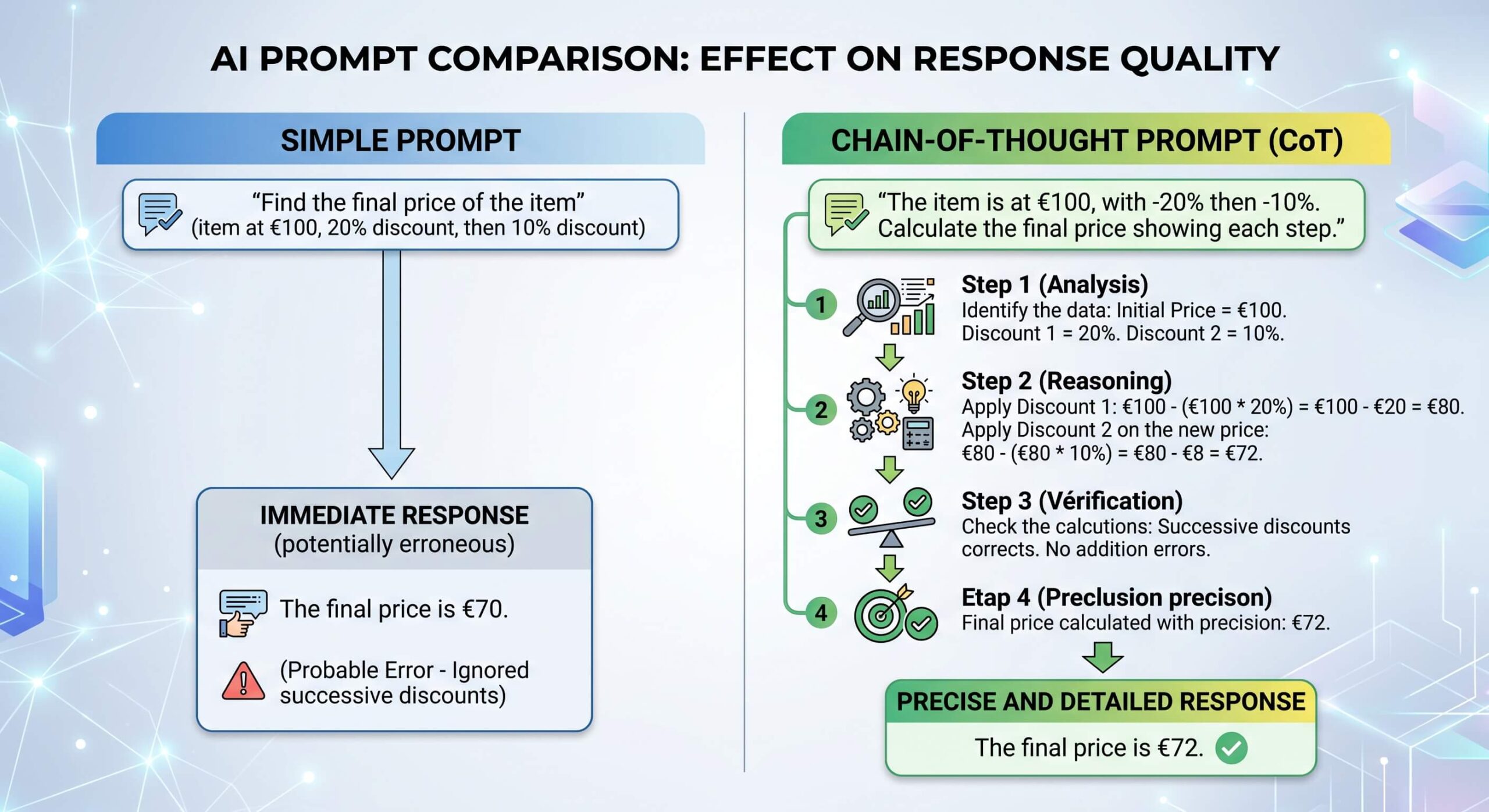
The Direct Impact of Structure on the Output
- The waste rate: An imprecise prompt generates up to 70% useless text that has to be rewritten manually.
- Semantic precision: Adding formatting constraints eliminates the most common factual hallucinations.
The most common mistake is treating artificial intelligence like a traditional search engine. However, a large language model doesn’t look for a pre-existing answer. It simply calculates the statistically most likely sequence of words. Consequently, if your initial request is flat, the output will be just as dull.
According to a 2023 study by Stanford University, the quality of the instruction influences the relevance of the output by up to 60%. This figure clearly shows that we can no longer settle for vague phrasing. In practice, I’ve found that a lack of context pushes the tool to make up facts. This is known as hallucination, and it wastes valuable time daily.
The Four Pillars of an Effective Prompt Structure
To structure every request, we apply a strict evaluation framework based on four core elements.

The Essential Components to Include
- The expert role: Determines the vocabulary and professional posture adopted by the virtual assistant.
- Negative constraints: Explicitly tell the model what not to do to avoid writing clichés.
To get a usable result on the first try, you need to build a solid architecture. I systematically use a precise method to formulate my work queries. I start by defining a specific role for the assistant, such as a proofreader or a seasoned developer. I also add detailed context explaining the situation and the intended goals.
Next, I specify the expected output format, whether it’s a three-column table or a bulleted list. Finally, I impose strict constraints to curb model drift. In my opinion, neglecting any of these pillars is like playing Russian roulette with your results. By integrating these four elements, you drastically reduce the need for back-and-forth corrections.
The Prompt Engineering Techniques Benchmark
Here is a comparison of performance across different prompting approaches based on task complexity.
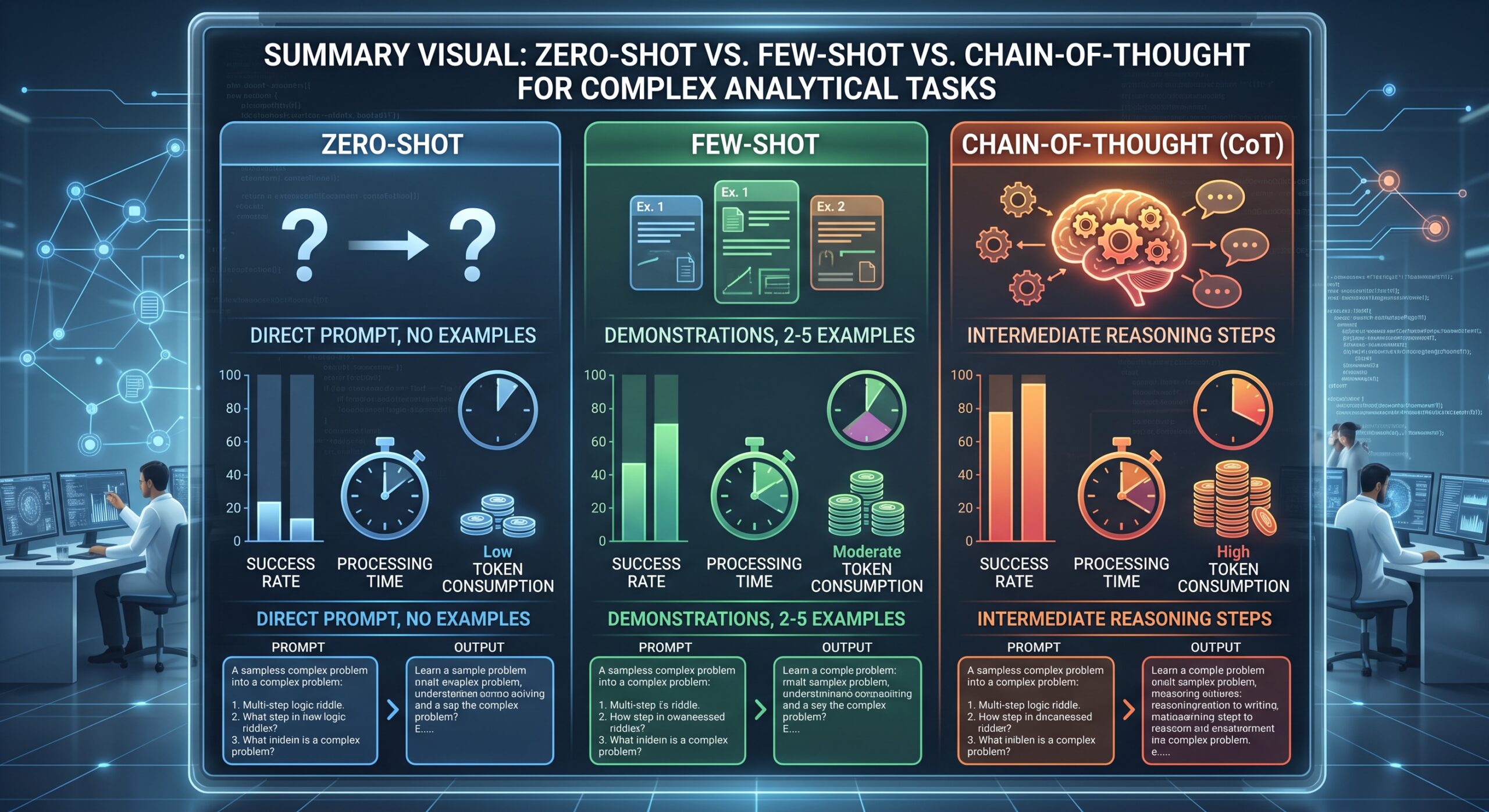
Choosing the Right Prompting Method
- The Few-Shot approach: This is ideal for enforcing a strict editorial guide using concrete examples.
- The Zero-Shot prompt: Handy for simple questions, it quickly reaches its limits with logical reasoning.
The simplest technique is Zero-Shot, where you ask a direct question without providing examples. It’s perfect for basic tasks like fixing a typo or translating a word. However, as soon as your needs get more complex, this method hits its technical limits.
That is where Few-Shot comes in—a powerful approach for formatting tone or writing style. By providing two or three examples of the expected output, you give the tool a visual template. Consequently, the assistant replicates the exact structure without you having to write long, abstract explanations.
I use this technique daily to write consistent product descriptions. It ensures flawless consistency from one text to the next. Another secret weapon is using negative constraints—in other words, telling the tool what not to do. For instance, I ask it to avoid cliché introductory sentences or excessive marketing jargon.
The Impact of Few-Shot on Brand Voice
One of the biggest challenges in content generation is maintaining a unique tone. Without specific examples, Claude or GPT-4o tend to default to a neutral, impersonal style. However, by embedding three examples of previously published copy, the model instantly captures your brand’s rhythm and vocabulary. Knowing how to write a good AI prompt requires this guided learning phase, which eliminates the need for rewriting.
The Chain-of-Thought Technique Under the Microscope
The impact of step-by-step reasoning on the accuracy of mathematical calculations and pure logic.
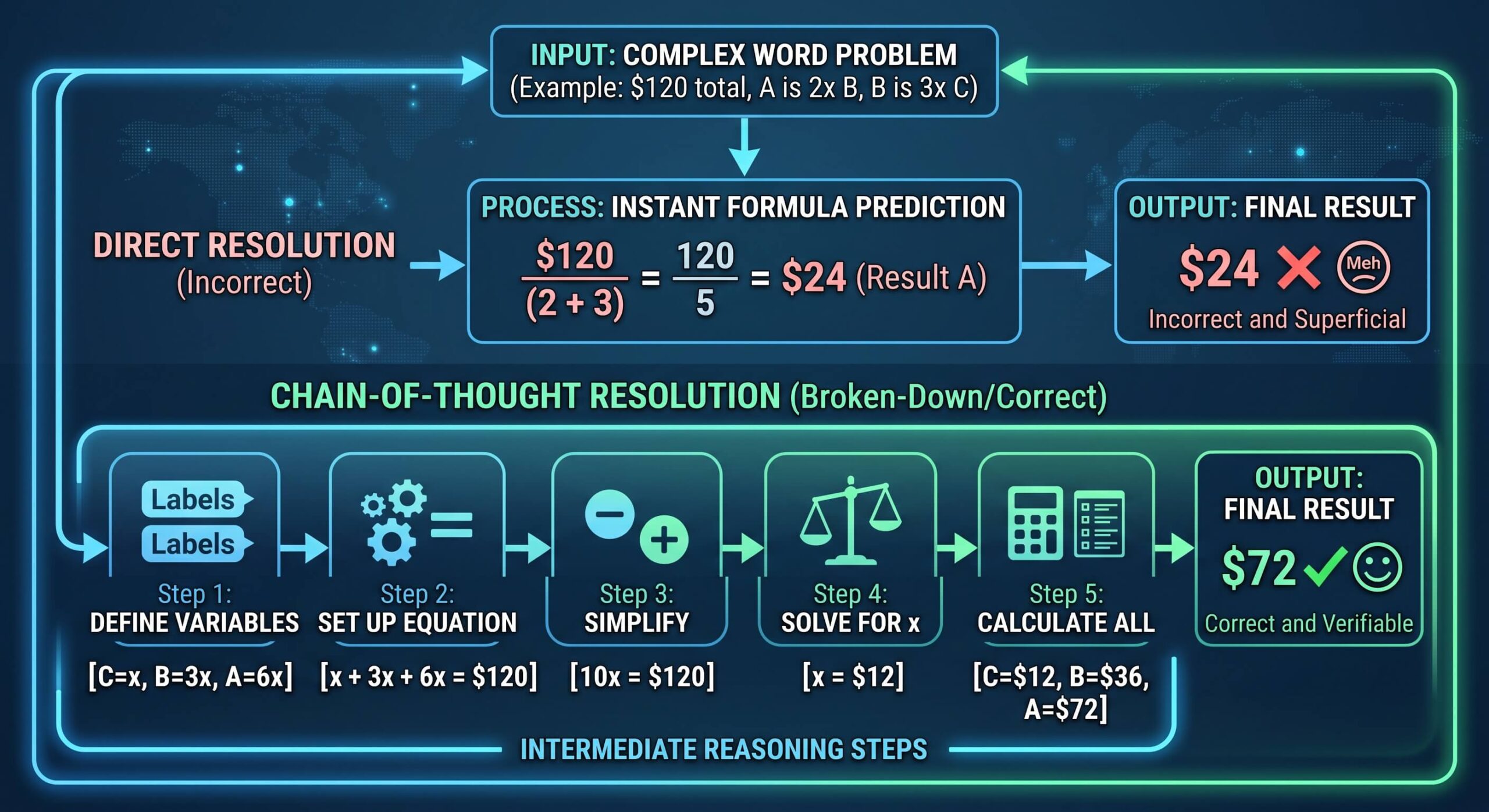
Why Breaking Down Steps Works
- Reduction in calculation errors: Forcing the model to lay out its intermediate steps eliminates false statistical shortcuts.
- Transparency of reasoning: Allows the user to immediately pinpoint at which step the error occurred.
Step-by-step reasoning, or Chain-of-Thought, is arguably the most significant breakthrough of recent years. A study published by Google Research in 2022 demonstrates that this method improves performance on complex logical tasks by 40% to 70%. Simply by asking the model to detail its calculations step-by-step, we prevent it from jumping to a hasty, incorrect conclusion.
I was able to test this technique while analyzing complex quarterly budgets. Without this breakdown instruction, Claude regularly made basic addition errors in the summary tables. However, as soon as it had to explain its reasoning, the calculations became perfectly accurate.
This approach shows that a model’s power doesn’t solely depend on its parameter size. How we guide its attention through the prompt plays an equally decisive role in the reliability of the outputs.
💡 Our Tech Analysis:
The art of structuring prompts isn’t just a geeky trick. It is a true temporary software interface. Until we have 100% autonomous agent systems, mastering these query structures is the only way to make consumer and API subscription costs worthwhile.
The Hidden Limits of Prompt Engineering
Despite the widespread enthusiasm, prompt engineering has a major flaw that many experts gloss over: its inherent fragility. A phrasing that works perfectly on one specific model can yield mediocre results on another. This lack of standardization forces us to constantly rewrite and adapt our instructions with every model update.
Moreover, token consumption quickly skyrockets when you stack examples and constraints. According to internal tests conducted in 2025, a highly structured prompt increases the processing cost of each query by nearly 300% compared to a simple request. On a large scale, this bill is hard for businesses to justify.
In my opinion, prompt engineering is just a temporary band-aid. Interfaces are already evolving toward agents capable of understanding our deeper intentions without complex query translation.
Model Dependency and Updates
Every time a provider updates its algorithms behind the scenes, our carefully optimized queries risk breaking. This lack of technical stability is a major barrier to integrating these tools into automated industrial processes. We must therefore remain vigilant and regularly test our prompts to ensure consistency. So, will we all be prompt engineers tomorrow, or simply managers of autonomous agents?
Chargement de la galerie…

About Rigaud Mickaël
"Creator of IActualité and uncompromising tech tester. Driven by intense analytical focus and surgical precision, I crash-test AI tools to bring you transparent, unfiltered verdicts. Passionate about Linux, robots, and pop culture!"



0 Comments