
🤖 Types of artificial intelligence: The ultimate guide to understanding it all (without messing with your head) 🌍✨
Yo! Artificial intelligence (AI), seriously, impossible to miss, right? It’s THE hot topic 🔥 that’s been shaking everything in its path for some time now. It’s revolutionizing entire industries and, let’s face it, it’s giving us a hell of a helping hand on a daily basis with tools we use H24 (often without even realizing it’s AI! 🤯). But here’s the cool (or complicated, depending!) thing: there isn’t just one AI, but several types of artificial intelligence. Did you know? 🤔
Weak AI, strong AI, ASI: the 3 levels of artificial intelligence
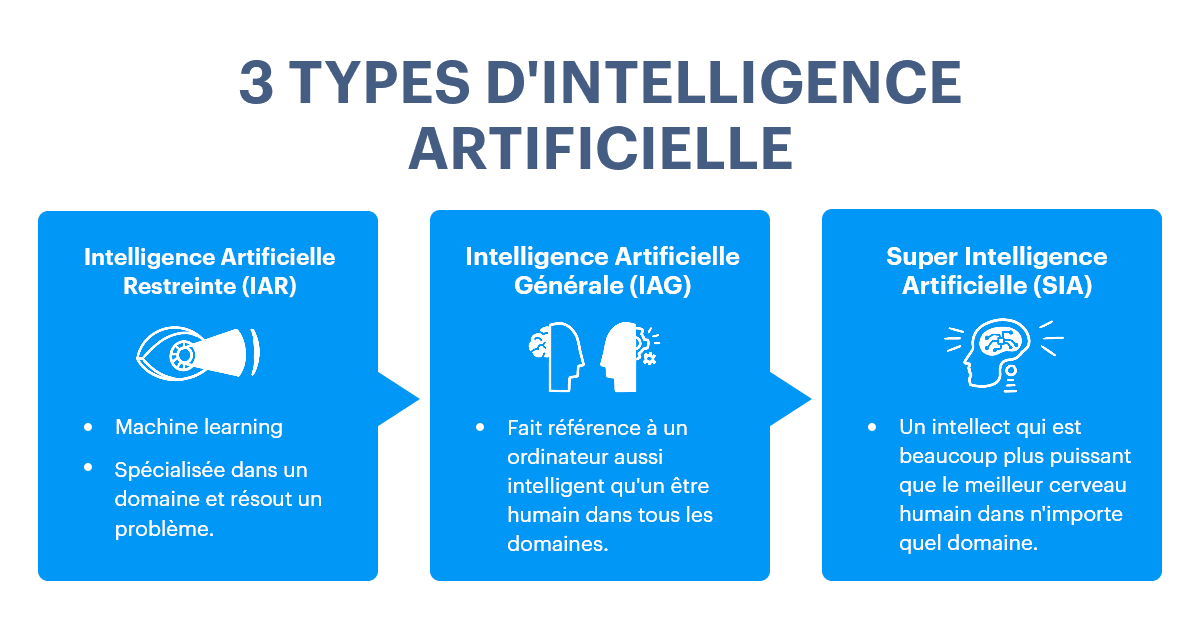
Basically, to put it simply, we can classify types of artificial intelligence into three big categories. First, you’ve gotnarrow AI (or“weak“, but it’s not that weak, believe me!). This is the one that’s everywhere, but like REALLY EVERYWHERE, in our lives. Let’s dig a little deeper: what exactly is narrow AI? And what are some examples of everyday narrow AI applications? Spoiler: there are plenty!
And finally, the ultimate level:superintelligent AI . Yeah, just like in the sci-fi movies, like Skynet in Terminator 🎥👽… Is this really going to happen? Let’s break down the risks and benefits ofsuperintelligent AI and imagine some future scenarios. Each category has its“superpowers” and, of course, its weak points (we’ll check out the limits of narrow AI, for example, and do a little comparison of narrow AI vs. general AI). In short, understanding these differences between AI types is the key to understanding how the future of AI will change our lives even more (and believe me, it will! 🌪️).
🔍 The 3 types of artificial intelligence: a quick recap 💡
Before we dive into the technical details (we promise to keep cool 😎), here’s a little chart – yeah, another chart, but this one’s useful, I swear! – to give you an overview of the three main types of artificial intelligence:| AI type | What’s this thing? 🤔 | Concrete example? 👍 |
|---|---|---|
| Narrow AI (ANI) | A super-specialized AI. It excels at ONE specific task, but ask it to do anything else, and it’s total nothingness. Let’s look at the limits of narrow AI and do a comparison of narrow AI vs. general AI to get the picture. | Your music app that suggests sounds 🎧, your phone’s facial recognition 🤳, Google Translate (even if it sometimes talks nonsense 😅). These are concrete examples of AI applications in everyday life. |
| General AI (AGI) | The Holy Grail! ✨ An AI capable of thinking, learning, and adapting like a human. For now, it’s mostly theory. The challenges of developing general AI are enormous, and one wonders when general AI will be available. Much is being written about its potential impact on humanity. | (For now, it doesn’t really exist) A robot like C-3PO or R2-D2 that can do everything: discuss philosophy, repair a ship, translate alien languages… 🤖 |
| Superintelligent AI (ASI ) | This is pure SF! 🤯 An AI that would surpass human intelligence in ALL areas (creativity, emotions…, problem solving…). The big ethical debate concerns the risks and benefits ofsuperintelligent AI and future scenarios. We’ll also see the difference between superintelligent AI and strong AI. | (Purely hypothetical) A “Skynet“-type entity that runs the world… or eliminates us 😬. The existential risks of superintelligent AI are a hot topic. |
Okay, now we break down the types of artificial intelligence in more detail. Hang on, here we go! 🚀
1️⃣ Narrow (or“weak“) AI: The star of our daily lives 🤩
This is the most widespread type of artificial intelligence, the one we come into contact with every day without necessarily realizing it. It’s really good at what it does. Like Netflix or Spotify recommendation algos that know you better than your own mother 🎬🎵 (this is one of the best-known examples of close everyday AI applications ). Or auto-translation on the web (well, okay, sometimes it’s a bit wonky 🤪). Even voice assistants like Siri or Alexa are narrow AI. It’s good at what it does, but take it out of its comfort zone and it’s completely lost. It’s important to understand what narrow AI is and what its limits are👉 In short: Super good at ONE thing. Versatility? Zero points!
2️⃣ General AI (AGI): The digital brain in the making 🧠
Now we’re moving up a notch in the AI categories. AGI is researchers’ ultimate fantasy: an AI with cognitive capabilities similar to our own. Able to reason, learn from any experience, understand abstract concepts, have a conscience (maybe? 🤔 )… In short, a real artificial brain. Imagine a machine that could hold a deep conversation, write a moving poem ✍️, or even invent a new scientific theory. For the moment, we’re a long, long way from that. The definition of general artificial intelligence (GAI) is clear, but the challenges of developing general AI are colossal (complexity of the human brain, need for monstrous computing power…). As a result, the question of when general AI will be available remains unanswered. What about its potential impact on humanity? A vast subject!👉 In short: The “human” AI we see in the movies. For now, it’s more science than fiction… but we’re working on it!
3️⃣ Superintelligent AI (ASI): Beyond Human? 🤯💥
Beware, then, we’re entering the territory of pure speculation and Hollywood-worthy scenarios! 🎬 ASI would be an AI that surpasses human intelligence in absolutely ALL areas: logic, creativity, social intelligence, wisdom… An entity so powerful it would be hard to imagine its capabilities. Would this be the key to solving all the world’s problems (disease, climate…) or the beginning of our end? 😬 This is THE big question mark and the heart of the ethical debate. The risks and benefits are enormous, and future scenarios range from technological paradise to robotic apocalypse. It’s also important to grasp the difference between superintelligent AI and strong AI (strong AI often being equated with AGI). The existential risks associated with superintelligent AI are taken very seriously by some experts👉 In short: It’s still very theoretical, but it raises some CRAZY questions about our future! (Fingers crossed 🤞)
🔥 Why is it crucial to understand the different types of Artificial Intelligence?
Because, frankly, it all depends on the type of AI we’re talking about! AI applications and consequences are not at all the same. It’s like comparing a moped to a Formula 1 car… then to an interstellar rocket, you get the idea? 😂- ✅ Narrow AI: It’s already here, improving our lives in tangible ways. Think of GPS that helps you avoid traffic jams (thanks GPS, I’d still be stuck on the ring road otherwise!), Insta filters that make you BG ✨, or systems that detect bank fraud. We’re going to see lots ofconcrete examples of applications in everyday life, but also for companies, in the healthcare sector, and in transport. It’s already a silent revolution.
- ✅ General AI: If it ever arrives, it could be a game-changer in terms of work and society. The potential is enormous, but the questions about its overall potential impact on humanity are dizzying. I say, as long as it helps me do my taxes and leaves me alone the rest of the time…
- ✅S uperintelligent AI: Our very survival could be at stake here. When it comes to superintelligent AI, let’s face it – there are some very real risks that should make us think twice. It’s now or never to ask the right questions about how to develop this technology without doing anything crazy! (I’ve seen too many movies with bad endings, maybe I’m just paranoid…)
📚 The basics of AI: Mini tech course to shine (a little) ✨🖥️
Today, AI is powered by cutting-edge techniques. A bit like me after 3 coffees, but much more efficient:
-
🤖Machine Learning ➡️ The machine learns on its own by analyzing tons of data. The more it eats, the smarter it gets (in theory!). A bit like my roommate who gets better at FIFA with each defeat… except that the AI ends up really progressing.
-
🧠Deep Learning ➡️ It’s a kind of machine learning on steroids, using complex artificial neural networks, somewhat inspired by our brains. It’s THE technology behind today’s most impressive AIs (image recognition, translation…).
-
🎮Reinforcement learning ➡️ AI learns by trial and error, just like when you play a video game. It’s rewarded when it succeeds, punished when it fails. This is how we train AIs to play chess or control robots. I’d like to be taught things like that too, with sweets when I succeed…
💥 Practical applications of AI: It’s already EVERYWHERE!
Okay, let’s stop with the theory 🤯. In concrete terms, where do we come across these different types of artificial intelligence? Get ready, the list is long! Maybe you haven’t even noticed how these digital critters have invaded your daily life!In your pocket 📱
Siri, Google Assistant, Snap/Insta filters, facial reco… It’s all AI! Even your alarm clock that gets it when you snooze, or your weird keyboard that guesses what you’re going to type, it’s not magic, it’s AI at work. 🤖For Business 🏢
Millimeter inventory, bots that talk to customers H24, targeted advertising like never before… Boxes are loving AI to boost their profitability. I’ve got a buddy in finance, his algos trade at a speed… even he doesn’t get it anymore 😅.In Healthcare 🏥
AI is giving doctors a real helping hand: reading imagery, detecting weird little things, robots in the operating room… Like detecting cancer before it even hurts? Crazy. And it’s not the future, it’s already here.In Transportation 🚘
(Nearly) autonomous cars, GPS that manages traffic jams, optimized deliveries… AI is revolutionizing commuting. But let’s be honest, I’m not quite ready to sleep soundly while Titine drives me home 😅. Someday, maybe!🏠 At your place: Narrow AI vs. potential General AI
Your voice assistants (Alexa, Google Home…) are a good example of the difference between narrow AI vs. general AI . Today, they respond to precise commands (narrow AI). Tomorrow, with AGI, they might be able to chat with you, understand your emotions, anticipate your needs… Scary or awesome? 🤔 These concrete examples of AI applications in everyday life show just how far we’ve come.
But beware, not everything is rosy in the land of AI! 😬 The future of AI also raises some serious ethical questions. What if our personal data were used against us? What if algos became racist or sexist without meaning to? What if AI stole all our jobs? 😱 These are the big ethical issues linked to the development of AI.
| Type of AI | Examples | Impact |
|---|---|---|
| Narrow AI | Voice assistants, photo filters | Already present ✓ |
| General AI | Global understanding systems | In development ⏳ |
| Super-IA | Intelligence superior to humans | Hypothetical 🔮 |
⚠️ AI’s big ethical challenges (no kidding!)
- Privacy & Surveillance 🕵️🔐 : Let’s face it, AI is totally addicted to data. But what’s left of our privacy in all this? Theimpact of AI on privacy is THE subject that worries me (and not just a little!). Who controls our personal information? How can we make sure we don’t all end up like in Black Mirror?
- Algorithmic biases 😬 An AI learns with what it’s given – logical, no? The problem is that if this data is full of prejudices (racism, sexism… you name it), well, the AI will amplify them to death! Frankly, knowing how to avoid algorithmic bias in AI is ultra-important if we don’t want to recreate an even more unjust society.
- Superintelligent AI & Control 🤖⚡ : Imagine for two seconds… If one day we make an ASI (that’s what we call a superintelligent AI), don’t you wonder how we’re going to keep it on our side? The debate on the existential risks of superintelligent AI is open, and not just a little! How can we control it if it’s millions of times smarter than we are? Makes you think, doesn’t it? Brrr… 🥶

🔮 The future of AI: Heading into the unknown? 🚀
👉 Come on, don’t worry! It’s not as complicated as it sounds. You too can start to understand the applications of AI and prepare yourself for tomorrow’s world (Spoiler alert: it’s going to be really exciting, even if it can be a bit scary…)
Focus on AI applications: Much more than gadgets! 🚀
1. AI in the healthcare sector: the medical revolution is underway! 🏥🩺
2. AI in transport: Towards smarter mobility 🚗💨🚦
- ➡️ Autonomous cars : The absolute dream (or nightmare, depending on how you look at it!) of being able to let you drive while you check your e-mails. The promise of safer roads (because, let’s face it, humans make plenty of mistakes behind the wheel), fewer traffic jams, and maybe even a positive ecological impact. It’s like having your own private chauffeur, but one who works 24/7 and never complains 🤩.
- ➡️ Intelligent traffic management : AI analyzes traffic in real time (via tons of sensors, GPS…) to optimize traffic lights, anticipate and avoid traffic jams before they even form, and offer you the best possible route. The ultimate traffic conductor 👨✈️! I tested this in Barcelona last year, and it’s amazing!
- ➡️ Optimized logistics : so your Amazon parcels arrive even faster (as if that wasn’t fast enough already, eh?) 📦! AI calculates the best routes for trucks, reduces costs and CO2 emissions. The super-logistician every supply chain manager dreams of!
- ➡️ Autonomous drones : For express deliveries, inspection of dangerous structures or agricultural surveillance. Ultra-efficient little robotic bees 🐝 that make our lives easier. I saw this being tested in my region, and it was crazy!
3. AI in business: the ultimate (and tireless) assistant 💼📈
- ★ Automation of boring tasks : Goodbye (and good riddance!) to data entry or sorting invoices! AI takes care of it, and humans can finally concentrate on more interesting stuff. Like having a perfect robot intern who never complains 🧑💼. I’m still dreaming about that in my company!
- ★ Next-generation chatbots : they answer customers 24/7, solve simple problems and constantly learn from their interactions. The customer service of the future (even if, let’s face it, sometimes they seriously get on our nerves 🤖). Have you ever tested your bank’s? I did, and it was… average!
- ★ Data analysis to the power of 1000 : AI deconstructs mountains of data (sales, marketing, customer behavior…) to unearth trends impossible to see with the naked eye. It’s like having a high-tech crystal ball for corporate strategists 🔮. A buddy who works in marketing showed me this, I was on the Q!
- ★ Content creation : Yeah, the AI can actually write texts (like this one? naaan, no way… though 😉 ), create amazing images, edit videos… A real creative Swiss army knife ✍️🎨🎬. Theimpact of AI on human creativity is hotly debated here! Personally, I use these tools but I always keep my personal touch.
The future of AI: Between dreams and nightmares 🔮👻
The promises: a better world thanks to code? ✨
The dangers: the uprising of the machines? 😱
The ethical debate: Finding the happy medium 🤔
- How can we concretely manage theimpact of AI on privacy(because I value my secrets, don’t you?)?
- How do we avoid algorithmic bias in AI, so that it doesn’t become just another tool of injustice? (We’ve got enough problems as it is!)
- What do we do about work in the face of rampant automation? (We can’t all become influencers, can we!)
- How do we keep control of a possible superintelligent AI? (THE question that makes me sweat profusely when I think about it too much 😅)
- And above all, who decides all this? GAFAM, which already has too much power? Governments? Or us, the ordinary citizens?
There are no simple answers to these questions, that’s for sure, but the debate has begun, and that’s something! The future of AI is in our hands, and it’s up to us to shape it intelligently (no pun intended, I promise 😉 ).
How to prepare for the future of AI: Personal instructions 🤓🚀
Wait, have you seen how AI is coming into our lives at breakneck speed?! Don’t panic, I swear! ✌️ Here are a few tips on how to prepare for the AI future without standing on the dock like a loser… (yeah, I know, I made a mistake, but it’s so much more stylish this way, isn’t it?) 😎

1. Learn, curiosity & continuing education! 📚💡
- Get the basics even without becoming a crazy coder (like my cousin Kevin, who sleeps with his keyboard…), understanding what distinguishes the 3 types of Artificial Intelligence, as well as machine learning and deep learning, helps demystify the whole thing.
- Get trained online courses (MOOCs…), YouTube tutorials, there are tons of resources, often free. I took Andrew Ng’s tutorial last year, and it was a blast!
- Read, inform yourself articles, blogs, books… Stay abreast of current trends in the future of AI and ethical debates.
- Go to events conferences, meetups… Meet people, exchange ideas, it’s all very stimulating! You learn as much over a beer as you do listening to the speakers, seriously! 🍻
A little advice between us… 🤫 Don’t wait until you’re too late to get started! AI is like Netflix: if you start too late, everyone has already seen the series you’re talking about!
2. Muscle up your “Human” skills 💪❤️
And just between us, I’ve never yet seen an AI laugh at a meme or enjoy a good glass of wine… So we’re still a few steps ahead! 🍷
3. Anticipating tomorrow’s jobs 🚀💼
- Direct AI jobs: AI developer, data scientist, machine learning engineer, AI ethicist… They’ll be recruiting like crazy! I’ve got a buddy who retrained 6 months ago, and he’s swamped with offers now.
- Jobs “augmented” by AI: Doctors using AI for diagnosis, marketers analyzing data with AI, teachers personalizing their lessons with AI… Learn how to use AI as a super-tool in your field.
- Human-based professions: Anything that requires empathy, pure creativity, human contact (care, education, arts…). My tip? Choose a job where you prefer a human, even an imperfect one, to a perfect AI!
So there you have it: a good overview of the different types of artificial intelligence, their applications, what’s at stake and what the future may hold. It’s a constantly evolving field, so stay curious! Oh, and you know what? AI’s role in solving the world’s problems could be huge, but it all depends on how we develop and use this fascinating technology. Personally, I can’t wait to see what happens! 😉🌍
🎥 Explanatory Video
Video automatically selected to enrich your reading